




 Inglés (pdf)
 Articulo en XML
 Referencias del artículo
 Traducción automática
 Enviar articulo por email
 Citado por SciELO
  Similares en
SciELO
Similares en
SciELO 
 Permalink

Introduction
The integration of neuroscience and marketing gives rise to neuromarketing, an emerging field focused on studying consumer behavior by analyzing brain responses to specific stimuli and decision-making processes. Through this interdisciplinary lens, the aim is to understand consumers' immediate reactions and the motivations driving their choices, offering a holistic approach that enables the creation of more effective and empathetic marketing strategies, thereby strengthening the relationship between brands and consumers (Cortés 2021; Covino et al. 2021; Goswami y Deshmukh 2022).
However, it was in 2002 when the term neuromarketing was first introduced by Professor Ale Smidts, who defines it as the study of the brain and its processing in activities related to the consumer context, including behavior and the reasons behind their purchasing decisions (Smidts 2002).
Marketing relies on both qualitative and quantitative methods to explore the complexity and depth of the subconscious processes that influence consumers' purchasing decisions. The integration of neurophysiological techniques, such as electroencephalography (EEG) and eye tracking, provides a more detailed perspective on consumer behaviors towards brands (Adhikari 2023; Nizam et al. 2022; Zhang et al. 2023).
Techniques such as electroencephalography (EEG) and eye movement analysis, along with functional magnetic resonance imaging (fMRI), provide effective and economically accessible methods to study consumers' brain responses to marketing stimuli. These tools, notable for their low cost, portability, and non-invasive nature, enable researchers to understand in real-time how marketing activities influence key aspects such as visual perception, emotions, memory, and decision-making (Shukla 2020).
These techniques are notable for being cost-effective and portable, making them important tools for behavioral researchers (Casas-Frausto et al. 2022; Stephens 2023). The combination of these methodologies provides marketing professionals with an integrated approach to understanding and influencing consumer actions. (Dzwigol 2020; Shukla 2020).
In the current business environment where Instagram influences purchasing decisions, consumers seek meaningful visual experiences. The integration of neuromarketing into the digital economy and commerce revolutionizes the implementation of products and services by emphasizing the importance of sensory perception (Bulut and Arslan 2020; Casas-Frausto et al. 2022; Covino et al. 2021; Mayorga et al. 2022).
Influencers on Instagram, with their personal and empathetic narratives, attract followers and enhance opinion leadership. Brands leverage them to reach their audience and promote a corporate identity through visual engagement (Riyanto et al. 2023; De Oliveira and De Moura Engracia Giraldi 2019; Adhikari 2023; Dixon 2024a)
The analysis of these interactions and visual effectiveness through eye-tracking techniques offers a comprehensive perspective on reactions to perceived stimuli. This technique demonstrates how images influence behavioral decisions, surpassing the limitations of conventional approaches ( Fisseha Dejene Yadete and Kant 2023; Parchure, Parchure, and Bora 2020; Stephens 2023; Casas-Frausto et al. 2022).
The primary objective of this research is to examine the attention levels of Instagram audiences towards visual stimuli of tea beverages, evaluating the impact on consumer behavior through an eye-tracking study.
Thus, it reveals how the brain responds to unconscious behavior to visual stimuli in fractions of a second, offering valuable components to enhance emotional connection in both digital and physical platforms. This ranges from web design to product presentation and shopping experiences across various platforms (Nizam et al. 2022; Mañas-Viniegra, Núñez-Gómez, and Tur-Viñes 2020).
Theoretical Framework
Neuromarketing: emociones, estímulos y decisiones de compra
The brain, composed of gray and white matter housed within the cranial cavity, plays a crucial role in the exploration of unconscious reactions. Zhang, Thaichon, y Shao (2023); Polácek (2018) highlight that neuromarketing offers a unique window into consumer cognitive and decision-making processes, emphasizing its impact on emotions and human decisions (Sweller 2022; 2023; Meshi, Tamir, and Heekeren 2015). This convergence of disciplines revolutionizes 21st-century marketing, providing a profound understanding of motivations on both conscious and subconscious levels. By identifying patterns and relationships through the analysis of emotional and brain responses, neuromarketing enhances brand effectiveness when applied to social media, digital marketing, and other multimedia platforms (Pérez-Quishpe and Castro-Analuiza 2024; Zhang, Thaichon, and Shao 2023; Casas-Frausto et al. 2022; Kohout, Kruikemeier, and Bakker 2023).
Visual Perception and Social Consumption
Visual perception is crucial in consumer behavior. Aesthetics, influenced by the consumer's prior knowledge and expectations, play a significant role in recognition, attention, and purchase decisions. Studies indicate that visual elements such as color, design, and layout significantly impact brand recognition and purchase intentions (Bercík et al. 2016). The analysis of visual complexity on platforms like Instagram reveals that higher visual saturation in images of food and beverages can increase purchase intention due to positive emotional responses ( Passebois Ducros, Euzéby, and Machat 2023).
Neuromarketing on Social Media
Particularly on platforms like Instagram, visual marketing has proven to be extremely effective. Studies in the beverage sector, such as tea and coffee, have examined how visual storytelling and experiential content enhance engagement and brand perception ( Bayu Wibisono et al. 2023; Amarnath and Jaidev 2023). Additionally, it has been demonstrated that visual complexity in food and beverage photographs on Instagram increases purchase intention, driven by positive emotional responses (Bercík et al. 2016; Passebois Ducros, Euzéby, and Machat 2023).
This approach not only encompasses consumer perception but also integrates an emotional connection, increasing the likelihood of loyalty and optimizing investments in business development (Olivar 2023).
Understanding Human Mental Processes in Marketing
Understanding human mental processes is crucial for developing effective visual content methods in marketing. Within this context, Paul D. MacLean's Triune Brain Theory (1998) provides a logical framework for analyzing brain complexity in a marketing setting. According to this theory, the brain is divided into three evolutionary structures: the reptilian brain, which manages survival and instinctive behaviors; the limbic brain, the center of emotions and motivations; and the neocortex, responsible for logical reasoning and creativity. Each of these structures governs different aspects of human behavior, ranging from survival to creativity (Rano Nazarova and Tuychiev Komilzhon Lazizovich 2019; Iloka and Onyeke 2020; Mansor and Mohd Isa 2020; Pereira, Córdova, and Díaz 2021).
In neuromarketing, the Triune Brain Theory helps design strategies that appeal to different levels of emotional and cognitive response, optimizing marketing campaigns to resonate on multiple psychological levels. Within the context of neuroscience, this framework is used to understand brain responses and analyze neural networks, allowing for the deciphering of consumers' decision-making processes and providing valuable insights into market dynamics (Abbad-Andaloussi, Lübke, and Weber 2023; Spence et al. 2016; Zhang, Thaichon, and Shao 2023).
The integration of knowledge about the primary areas of the reptilian, limbic, and neocortical brain in neural marketing revolutionizes tactics by addressing basic human, emotional, and cognitive needs. This approach enriches marketing methods by transforming our understanding of the motivations behind purchasing decisions and interactions with commercial stimuli (Bigné, Ruiz-Mafé, and Badenes-Rocha 2023; Bulut and Arslan 2020; Goswami and Deshmukh 2022; Pereira, Córdova, and Díaz 2021).
Psychological Theories in Predicting Consumer Behavior
Underlying theories provide a framework for understanding buyer behavior, supporting the comprehension of neuromarketing, and optimizing visual algorithmic interpretation.
Social Judgment Theory, formulated by Sherif, proposes that customers seek consistency between their perception of marketing stimuli and their pre-existing beliefs and attitudes. This principle aids in understanding and predicting how users accept or reject new information, emphasizing the importance of congruence in communication (Sherif 1963). According to this perspective, visual perception influences the acceptance or rejection of messages that contradict personal beliefs (Sweller 2022).
Developed by Heider (1958), Balance Theory suggests that consumers adjust their beliefs to achieve cognitive equilibrium when faced with conflicts. This adjustment is crucial for understanding changes in consumer appreciation of contradictory content, providing a foundation for designing neuromarketing methods that minimize cognitive dissonance and enhance the reception of advertising messages (Pittman and Haley 2023; Durmaz and Bakan 2023; Pérez-Quishpe and Castro-Analuiza 2024).
Cognitive Dissonance Theory, proposed by Festinger & Holtzman (1978), suggests that individuals seek confirmation to minimize psychological conflict. This phenomenon is essential for understanding how customers handle post-purchase regret and strive for consistency between their decisions and pre-existing attitudes. This drive for coherence can significantly influence brand loyalty and subsequent product perception (Mansor and Mohd Isa 2020; Holley and Miller 2022).
Additionally, Learning Theory, supported by various authors, posits that buyers adjust their beliefs and attitudes based on their experiences, whether positive or negative (Bandura and Jeffrey 1973; Musyafa'ah and Ulin Nuha 2022). This continuous adjustment explains how consumers adapt in response to their consumption experiences, highlighting the ability of sensory marketing to anticipate and shape customer responses through the strategic use of stimuli in the commercial domain.
The Gestalt principles, as discussed by Koffka (2013), assert that individuals organize perceived stimuli into coherent and unified patterns. This understanding enhances our ability to predict how consumers perceive marketing stimuli as an integrated whole, emphasizing the importance of cohesive visual design in the effectiveness of advertising campaigns (Muñoz-Leiva, Hernández-Méndez, and Gómez-Carmona 2019; Eroglu and Kucun 2020).
Similarly, Information Processing Theory illustrates how visual perception develops through key stages: selection, organization, and interpretation of stimuli. Within the marketing context, the clarity, relevance, and attractiveness of visual stimuli are crucial for capturing user attention and ensuring the retention of advertising messages. This doctrine underscores the importance of structuring communications that not only capture attention but also facilitate the memorization and understanding of content (Broadbent, 1958; Sucharitha et al. 2020).
In contrast, Selective Attention Theory proposes that the mind discriminates and selects certain visual stimuli for more detailed processing while disregarding others. This phenomenon is particularly relevant in the field of neuromarketing, where understanding which visual elements capture attention can guide the design of advertisements and packaging that stand out in an information-saturated environment (Treisman and Gelade 1980).
On the other hand, Cognitive Load Theory addresses how the amount and complexity of information impact the brain's ability to process and retain data. Applied to neuromarketing, this principle underscores the necessity of designing visual experiences that are simple yet impactful, minimizing informational overload to enhance communicative efficacy (Sweller 1988).
The integration of these theoretical frameworks into the development of neuromarketing plans allows brands to construct more persuasive and effective image campaigns. This enhances the understanding, interpretation of reactions, and prediction of consumer behavior trends, optimizing commercial outcomes. By applying these principles of visual perception, companies can design experiences that not only capture attention but also foster a deep emotional connection with their audience, thereby boosting the effectiveness of their business initiatives (Kahneman 1973).
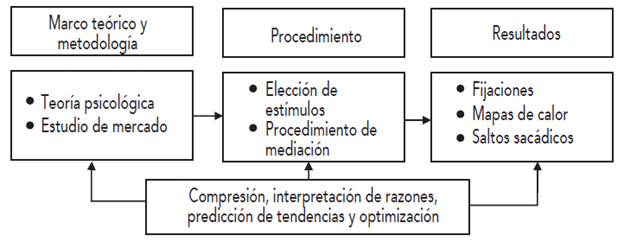
Eye tracking in Purchase Decisions
Eye-tracking is a technique used in neuromarketing that employs devices with integrated infrared sensors and measurement glasses to capture light reflected by the eyes in real time. This methodology measures critical parameters such as fixation times, saccadic movements, and heat maps. By analyzing how individuals view advertisements and products, it determines the most attractive areas of a stimulus and evaluates the distribution of attention, providing a precise focus on visual interaction for predictive modeling. This analysis helps identify the most engaging elements of advertisements and products, offering valuable insights into how attention is distributed, and enabling more accurate predictions of consumer behavior (Guerrero Salinas 2023; Rusnak 2021; Jacob and Karn 2003).
To interpret eye-tracking software, the data is classified into the following categories: the duration of the first fixation corresponds to the time the user remains at this initial point (Peake et al. 2020). Total fixations refer to the sum of all instances where users' gaze stops at different fixation points, all recorded in milliseconds (Taguacundo 2022). Finally, areas of interest (AOI) indicate the specific zones that generate the most attention or interest from users (González-Mena et al. 2022).
Stimuli on Instagram
According to Fernández (2023), Instagram has emerged as the predominant platform for brands focusing on digital marketing. Companies invest between 20% and 50% of their communications budget in these digital networks, resulting in an approximate annual investment of $51 billion dedicated exclusively to digital commerce up until 2022.
Dixon (2024b) reports that, according to a global online survey conducted in 2022, Instagram users have specific preferences regarding the types of posts: 50% prefer entertaining content; 46% prefer creative content; and 41% prefer informative content. Additionally, more than one-third of users favor engaging informative material on this social network.
In the commercialization of sugary beverages, understanding consumer preferences is essential for brand differentiation. Among prominent firms, this article focuses on the Fresno brand, which stands out for combining digital advertising with external promotions and public events. This holistic approach aims to attract customers by blending online interactions with reallife experiences (West 2020).
Methodology
This study employed a non-probabilistic quantitative design to examine consumer behavior in response to visual stimuli on Instagram, focusing on eye-tracking to capture responses to these stimuli. A pre-experimental method was applied, which, as noted by Reguera (2008), does not include a control group and is limited to a single measurement, significantly simplifying implementation. By manipulating and controlling selected variables, this research falls within the category of experimental studies.
Study Population
In Ecuador, sugary beverages constituted 88% of the total beverage consumption in 2017, with tea being one of the predominant options. This research specifically focused on Ambato, a city in the province of Tungurahua, analyzing young adults aged 20 to 24 years. Of this group, 55.3% are women, primarily university students and athletes. Additionally, 92% of Tungurahua residents consume tea, mainly in urban areas (Mayorga et al. 2022; Zapata 2021; Ecuador en cifras 2020a).
The study sample consisted of 20 individuals from Ambato, evenly distributed by gender. All participants were students from the Technical University of Ambato and active Instagram users dedicated to promoting healthy lifestyles. The selection of subjects was based on predefined criteria, ensuring a faithful representation of the target group and contributing to the robustness of the findings validity (Choez 2016; Del Alcázar 2015a; Mayorga et al. 2022; Ecuador en cifras 2020a; Carvajal 2021).
Table 1 Segmentation of potential consumers of the Fresno Tea brand
| Variable | Data |
|---|---|
| Geographic | Tungurahua 597099 Ambato 391627 |
| Demographic | Male 189761 Female 201 866 Age from 20 to24 years: 35 546 |
| Behavioral | Universidad Técnica de Ambato students 18 000 Instagram Users 13 862 Fresno Tea Users 5000 |
Source: Ecuador en cifras (2020b); Instituto Nacional de Estadística y Censos (2010); Ipsos (2015); El Universo (2021); Del Alcázar (2015b).
Selection of Stimuli
For the selection of stimuli on Instagram, advertising images from the Fresno brand representing three distinct flavors of their products were chosen. These images, in a square format of 1080 x 1080 pixels optimized for full view in the feed, integrate elements such as the bottle designs, which visually reflect the tea flavors, the brand, natural components, and leaves evoking a connection to the organic. Each visual detail is designed to capture the consumer's attention, employing simple typography and a monochromatic background. The content of the posts uses direct and persuasive language.

Procedure
Each experimental session lasted approximately one minute and eight seconds per participant. Of this time, the first forty-seven seconds were allocated to calibrating the eye-tracking equipment, although this period could vary depending on the subject. Subsequently, three consecutive visual stimuli were presented, each lasting five seconds, with no waiting intervals between them.
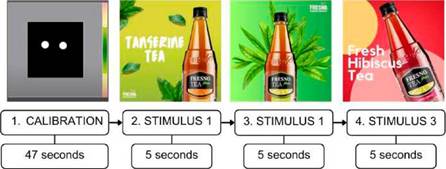
The experimentation was conducted using Tobii software, designed to track participants' eye movements, and the Tobii Pro Spark mechanical device, equipped with a camera that captures images of both eyes. This setup allows for precise measurement of eye direction and position in a three-dimensional space (Pastor 2013).
The testing of Instagram posts was conducted in the city of Riobamba, located in the province of Chimborazo, where the specialized neuromarketing laboratory "Neurolab" is situated. Participants were guided through two rooms to complete the experiment: the first served as a waiting room, while the second was designated for the eye-tracking procedure.
Next, analysis of variance (ANOVA) was employed to determine if there were significant differences among the three stimuli, allowing for the comparison of means across multiple groups. Once significant differences were identified, the Tukey test was used to pinpoint which specific stimulus or combination of stimuli generated a significantly different ocular response compared to the others.
This analysis helped understand which elements of the visual content had a significant impact on participants' attention, providing valuable insights for adjusting and optimizing future content design strategies on Instagram.
Presentation, Analysis, and Discussion of Results
The results were analyzed using the areas of interest coded as AOI 1 (Background), AOI 2 (Packaging), and AOI 3 (Linguistic Code). Fixations were classified into first fixation (F1), duration of the first fixation (F2), and total fixations (F3). Below is a comparison of the average values for each type of fixation, expressed in milliseconds.
From the table 2, the first fixation (F1), it is observed that the product packaging (AOI 2) initially captured the consumers' attention, with the lowest values in each stimulus (S1: 1.26 ms, S2, and S3: 1.45 ms). The bold values indicate the most significant in each category. It is important to note that for this fixation, only the lowest values are considered.
For the duration of the first fixation (F2), it is interpreted that consumers spent more time observing the packaging (AOI 2), reflected in the highest values of the first fixation duration (S1: 3.95 ms, S2: 2.45 ms, S3: 2.30 ms).
Finally, in the total fixations (F3), it is analyzed that, similar to F2, the packaging (AOI 2) also had the highest number of total fixations, standing out as the element of greatest interest (S1: 4.05, S2: 2.45, S3: 2.35).
Table 2 Comparison of Average Values for Each Fixation
| First Fixation (F1) | Duration of the first (F2) | ||||||
|---|---|---|---|---|---|---|---|
| Black Tea (S1) | Hibiscus (S2) | Mandarina (S3) | Black Tea (S1) | Hibiscus (S2) | Tarentine (S3) | ||
| AOI 1 | 2,24 | 2,60 | 2,38 | AOI 1 | 1,35 | 1,75 | 1,45 |
| AOI 2 | 1,26 | 1,45 | 1,45 | AOI 2 | 3,95 | 2,45 | 2,30 |
| AOI 3 | 2,50 | 2,30 | 2,25 | AOI 3 | 1,75 | 1,55 | 1,40 |
| Total fixation (F3) | |||||||
| Black Tea (S1) | Hibiscus (S2) | Tarentine (S3) | |||||
| AOI 1 | 1,95 | 1,60 | 1,30 | ||||
| AOI 2 | 4,05 | 2,45 | 2,35 | ||||
| AOI 3 | 1,30 | 1,30 | 1,35 | ||||
Note: In the analysis of the first fixation (F1), the lowest values are initially prioritized. The values highlighted in bold are the most significant for the analysis.
Source: Own Elaboration.
Heat map analysis
For Figure 4, the heatmaps provide an intuitive visualization of the areas that capture concentration in an image, using a color scale ranging from green, indicating areas of lower interest, to red, indicating zones of high attention (Cuesta 2012). In the analysis of the three Instagram ads for the Black Tea, Jamaica, and Mandarina flavors, the accumulation of red colors is particularly notable on the labels of the packaging, specifically over the brand name Fresno Tea.
This result suggests that the brand name is the most effective element in attracting user interest, quickly and clearly communicating both the benefit and identity of the product. In contrast, other elements such as the linguistic code and the background do not show a predominance of red in the heat-maps, indicating that they do not significantly capture attention nor are they perceived as relevant elements by consumers.

Saccadic eye movement analysis
Saccadic eye movements facilitated the measurement of focus points between objects, reaching speeds of up to 900 degrees per second and lasting between 20 and 200 milliseconds. This variability in duration was influenced by the individual and the specific stimulus, as determined from the analysis of the visual information processed from the results obtained.
Figure 5 illustrates the results of saccadic eye movements across three different visual stimuli, each corresponding to a type of tea marketed by Fresno. In the first panel, "Tangerine Tea", it is observed that ocular fixations concentrate on the central and upper parts of the bottle, as well as on the label text, particularly highlighting the numbers from 1 to 5 and from 6 to 11. The visual path begins with the text and then shifts towards the bottle, with significant movements, especially between numbers 17 and 15, indicating interest in the upper part of the packaging.
In the second panel, dedicated to "Black Tea", the fixations are distributed between the text and the bottle, similar to the first stimulus. Key fixation points include the area around the "Fresno" logo and the main text on the label. A movement pattern is evident that goes from the text to the bottle, passing through the logo and decorative images on the bottle, indicating a detailed exploration of the label and design.
Finally, the third panel, "Fresh Hibiscus Tea", shows a distribution of fixations primarily covering the text "Fresh Hibiscus Tea" and the bottle's graphic design. The fixations span over the label and the image of the packaging, with saccadic movements that also start from the text and progress towards the most visually attractive areas of the packaging.

Homogeneity of Variance Analysis in Three Areas of Interest
In Table 3, the Levene's test did not reveal significant differences in variances for the measures F1, F2, and F3 across the three areas of interest (AOI 1, AOI 2, AOI 3). The significance values, which ranged from 0.154 to 0.936, confirmed the homogeneity of variances, facilitating the use of analysis of variance (ANOVA) without the need for adjustments due to inequality of variances among the groups.
Table 3 Homogeneity of Variance Test
| AOI | Measure | Levene's Statistic | dfl | df2 | Sig. |
|---|---|---|---|---|---|
| AOI 1 | F1 | 0,401 | 2 | 57 | 0,671 |
| AOI 1 | F2 | 0,457 | 2 | 57 | 0,154 |
| AOI 1 | F3 | 0,745 | 2 | 57 | 0,184 |
| AOI 2 | F1 | 0,523 | 2 | 57 | 0,869 |
| AOI 2 | F2 | 0,412 | 2 | 57 | 0,528 |
| AOI 2 | F3 | 0,254 | 2 | 57 | 0,837 |
| AOI 3 | F1 | 0,338 | 2 | 57 | 0,715 |
| AOI 3 | F2 | 0,387 | 2 | 57 | 0,066 |
| AOI 3 | F3 | 0,066 | 2 | 57 | 0,936 |
Source: Own Elaboration.
ANOVA
In Table 4, the analysis of the first fixation (F1) across Areas of Interest (AOIs) revealed significant differences in the means between groups for AOI 1 (Background) and AOI 2 (Packaging), with p-values of 0.025 and 0.008 respectively. This leads to the rejection of the null hypothesis (H0) and the acceptance of the alternative hypothesis (H1), indicating significant differences between groups for these areas.
In contrast, for AOI 3 (Linguistic Code), the null hypothesis was not rejected (p = 0.820), indicating the absence of significant differences in first fixations on the linguistic code among the evaluated groups. This result suggests that initial attention is concentrated more on the background and packaging rather than the text associated with the visual design.
On the other hand, the analysis of the duration of the first fixation (F2) shows that for AOI 1 (Background), the p-value is 0,225, and for AOI 3 (Linguistic Code), the p-value is 0.334. In contrast, for AOI 2 (Packaging), the p-value is 0.000, leading to the acceptance of the alternative hypothesis (H1), indicating significant differences, and the rejection of the null hypothesis.
The total fixations (F3) reveal a similar pattern. For AOI 2 (Packaging), the alternative hypothesis is accepted with a p-value less than 0,000. For AOI 1 (Background) with a p-value of 0,386 and AOI 3 (Linguistic Code) with a p-value of 0.956, the null hypothesis is maintained for both fixations, indicating the lack of statistically significant differences in the duration of fixations and the total number of fixations, respectively.
HSD Tukey
In Table 5, the results of the Tukey test for Background and Linguistic Code indicate that there are no significant differences in how consumers perceive these aspects among the three products. However, for the Packaging variable, there is a clear distinction in how Black Tea is perceived compared to Mandarina and Jamaica. This suggests that the packaging design of Black Tea is distinctive, highlighting its importance in product differentiation in the market.
Table 5 Tukey's analysis of Packaging as significant value
| Variable | N | F1 | F2 | F3 | |||
|---|---|---|---|---|---|---|---|
| Subset for alpha = 0,05 | Subset for alpha = 0,05 | Subset for alpha = 0,05 | |||||
| 1 | 2 | 1 | 2 | 1 | 2 | ||
| Tarentine | 20 | 1,2645 | 2,2950 | 1,3000 | |||
| Hibiscus | 20 | 2,3815 | 2,4500 | 1,6000 | |||
| Black tea | 20 | 2,5995 | 3,9500 | 4,0500 | |||
| Sig. | 1,000 | 0,873 | 0,910 | 1,000 | 0,396 | 1,000 | |
Source: Own Elaboration.
Conclusions
The eye-tracking technique, applied in neuromarketing, reveals patterns of visual attention by calculating the exact position of the gaze in real-time using light reflected from the eyes. This methodology, which includes the analysis of fixation times, heatmaps, and saccadic movements, identifies the areas of the stimulus that are most attractive to the observer. The results obtained facilitate the development of more effective marketing strategies and improve the prediction of consumer behavior.
The collected data were organized into categories such as the duration of the first fixation and the total number of fixations, evaluating the time users concentrate on specific points, as well as areas of interest (AOI), which denote zones of greatest appeal. Additionally, the influence of packaging design on capturing and retaining attention was highlighted, emphasizing its relevance in product perception.
The analyses also show variations in saccadic movements, influenced by specific visual elements of the packaging. The fixation patterns demonstrate the design's ability to direct consumer attention towards key elements such as text and graphics on the labels, highlighting the importance of visual components in capturing buyer interest and enhancing brand awareness, which contributes to increased sales.

