




 Español (pdf)
 Articulo en XML
 Referencias del artículo
 Traducción automática
 Enviar articulo por email
 Citado por SciELO
  Similares en
SciELO
Similares en
SciELO 
 Permalink

Introducción
English as a Foreign Language (EFL) education has witnessed a remarkable shift toward online learning platforms in the digital age. These virtual environments offer numerous advantages, such as flexibility, accessibility, and diverse resources, enhancing language learning experiences for students worldwide. However, despite these benefits, online learning may also pose challenges, one of the most prominent being the prevalence of anxiety in written production among EFL students..
Anxiety in written production refers to the apprehension and uneasiness experienced by EFL students when engaging in written tasks or assignments. As students strive to express their thoughts and ideas accurately in a foreign language, they often face various psychological barriers that hinder their language production. A study by Shen et al. (2018) reported that some EFL students in this research indicated moderate to high test anxiety during written tasks.
Several factors contribute to the high levels of anxiety experienced by EFL online students. Firstly, the absence of face-to-face interactions with instructors and peers in virtual classrooms might lead to a lack of immediate feedback and support, further amplifying students' writing anxiety (Liu et al., 2024). Secondly, the fear of making grammatical errors or using inappropriate vocabulary can hinder students' confidence and willingness to engage in written communication (X. et al., 2019). Lastly, the pressure to perform well academically and achieve high proficiency levels in a limited time can lead to overwhelming stress and anxiety (Cheng et al., 2021).
The detrimental effects of anxiety on EFL students' written production are well-documented in the literature. Studies by McGrath et al. (2016) and Li (2022) found that heightened anxiety levels were associated with decreased writing performance and motivation. Students experiencing anxiety may also demonstrate a lack of creativity and innovation in their written expressions, as they tend to opt for safer, less complex language structures to avoid potential errors. Walker (2021) stated that participants perceived the peer review intervention to help improve their writing performance and feelings about writing.
To address the issue of anxiety in EFL online writing, educators and institutions have been exploring various coping strategies. Providing timely and constructive feedback on written assignments can help alleviate students' uncertainty and enhance their self-assurance. Learners who experience higher levels of self-efficacy tend to be more resilient foreign language writers (Yoon, 2022). Additionally, incorporating collaborative writing tasks that promote peer interactions can foster a supportive environment and reduce the sense of isolation experienced by students (Li, 2019). Moreover, integrating mindfulness techniques into language learning activities has reduced anxiety and improved linguistic competence (Cheng, 2004)
Anxiety in written production is a prevalent challenge EFL online students face, impacting their language learning progress and overall confidence in using English as a foreign language. Recognising the contributing factors and implementing effective coping strategies can significantly improve students' written production experiences in the online learning environment. As the field of EFL education continues to evolve, further research is necessary to understand better and address the complexities of anxiety in written production, ultimately fostering more effective and supportive language learning experiences for EFL online students; even more relevant, this is when the language learners are pre-service English teachers.
Metodología
This research was conducted at Universidad Técnica del Norte, an accredited public Ecuadorian university. The target population was English-significant students who were pre-service English teachers. This study was descriptive, with no experimental research design. The information to be gathered was aimed at answering the research question: What anxiety levels are experienced while writing in English? To this effect, an online questionnaire was created in Microsoft Forms, which contained nine questions based on a scale, the main instrument, detailed below. This scale has been validated by language and linguistics teaching experts and applied in other research works (Anonby et al., 2016; Esmaeli et al., 2015; Khosravi et al., 2023; Liu et al., 2015; Tugan, 2015), among others.
Participants
The target population consisted of all the significant English students in the Pedagogy Program for Teaching English at the Faculty of Education, Science, and Technology from Universidad Técnica del Norte, Ecuador, during the academic semester October 2021 - February 2022. The total number of participants was two hundred fifty studies from the first to eighth English Major levels, as detailed below in Table 1. These pre-service English teachers range from A1 to B2, international with standards aligned to the Common European Framework. The undergraduate English students were informed about this study, and their consent to participate was received before the questionnaire application. It is pivotal to clarify that the English central participation was voluntary.
Instruments
This study applied only one instrument for data collection. The primary research instrument was the Writing Test Anxiety Scale developed (WTAS: Driscoll, 2007). The WTAS consists of 10 items, each of which is graded on a Likert scale from “very, always true” to “not at all, never true” by the participants. Then, the WTAS scale used was made of nine questions. The first five items tested Incapacity (memory loss and poor cognitive processing), and the last four measured Worry and dread (i.e., catastrophising), which interferes with focus, producing an overall anxiety score that evaluates anxiety impairments.
Procedure
Once the questionnaire was elaborated, a pilot test was applied to minimise the bias of the results and report valid findings. The participants received the link to the questionnaire and responded online. Afterwards, the Westside Test Anxiety Scale responses were analysed descriptively based on the scoring methodology for the WTAS. Data was used to draw this study’s main conclusions about test anxiety in significant English students within the Ecuadorian context.
Resultados
The results evidence that the anxiety students experience before a test generally ranges between Moderately, Highly, and Extremely accurate. Consequently, fear is evident in significant English students from the first to the eighth level. It is relevant to point out that the percentage of anxiety is present in students regardless of the story; for instance, the first level revealed 35% and seventh-level students 36.10% in Highly True.
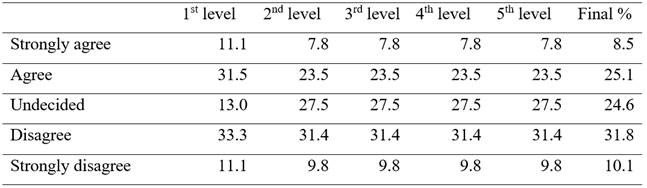
Based on the results, many participants experience nervousness or anxiety while writing in English. The combined percentage of those who Disagree or Strongly Disagree with the statement amounts to 41.9%, while Undecided, 24.6%, suggests that EFL writers might or might not be anxious about their writing.
The participants evidenced that 33.6% are relaxed about writing in English. Research has also demonstrated that confidence and positive attitudes toward the target language can enhance language learning outcomes.
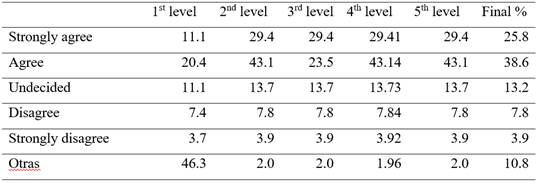
Table 2: I feel my heart pounding when I write English compositions under time constraints.
Source: elaborated by the authors
Regarding time constraints, most of the students Agree (38%) and Strongly Agree (25.8%), which evidences that time pressure is a predictor of writing anxiety). A low percentage of 3.9% evidences a strong disagreement because a (3.9%), and this lack of nervousness while writing in English may also suggest that they have developed a positive attitude towards this language.
Table 3: While writing English compositions, I feel worried and uneasy if I know they will be evaluated.

Source: elaborated by the authors
Writing anxiety in EFL learners is often linked to evaluation or assessment, as stated by Zhang and Wu (2021); thus, this statement is supported by the results evidenced by these Ecuadorian participants who Strongly Agree (31,8%) and Agree (46,6%) when asserting that they feel concerned while writing because their compositions will be evaluated.
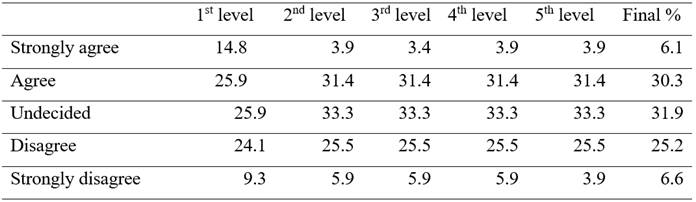
This table reveals that a significant proportion of respondents (30.3%) Agree or even higher (31.9%) are Undecided about avoiding writing English compositions. Hence, students who Disagree with this statement (25.2%) evidence that learners are aware that developing English writing skills is part of the language learning process.
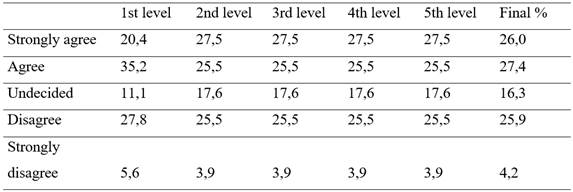
Table 5: My mind often goes blank when working on an English composition.
Source: elaborated by the authors
The results depicted in Table 5 show that a significant proportion of participants (approximately 61% in total) agreed or strongly agreed with this statement. This finding suggests that time pressure may be a considerable source of anxiety for many EFL learners when writing in English.
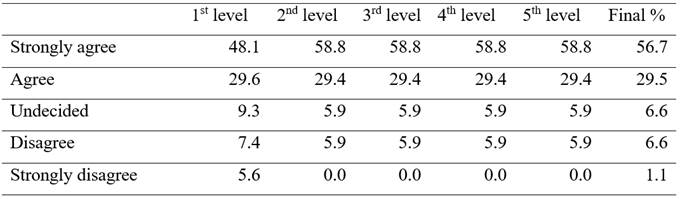
Table 6: If my English composition is to be evaluated, I would worry about getting an inferior grade.
Source: elaborated by the authors
A large proportion of participants (approximately 86%) agreed or strongly agreed with this statement. This finding highlights the significant role that evaluation and assessment can play in causing anxiety for EFL learners in writing in English.
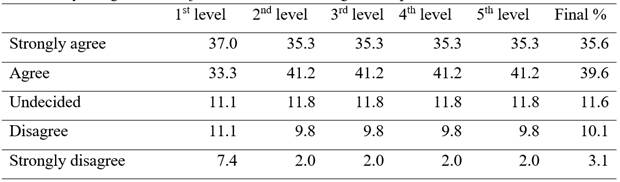
Table 7: My thoughts become jumbled when I write English compositions under a time constraint.
Source: elaborated by the authors
Based on the results in Table 7, it can be inferred that many EFL learners need help organising their thoughts and ideas when writing English compositions under time pressure. Most participants either agreed or strongly agreed (39.6% and 35.6%, respectively) with the statement, indicating that time constraints may significantly challenge their writing process. Moreover, a small percentage of participants disagreed or strongly disagreed with the word (10,1% and 43,1%, respectively), suggesting that most EFL learners are likely to experience this difficulty somewhat. Previous research has also identified time pressure contributing to writing anxiety and affecting writing quality (Miyamoto & Wilbur, 2013; Saito & Fujita, 2004).
Discusión
Anxiety seems to be a normal condition when students face the writing process under pressure in the classroom. The anxiety level may decrease if disregarded. This aligns with Azimi (2016), who asserts that people often experience worry or fear before confronting a challenge such as a test. However, anxiety is considered a problem when the symptoms interfere with a person's sleep and concentration (see Table 1). According to past and current research in the EFL field, language anxiety is a phenomenon among English learners that can significantly affect their language learning and performance (Dewaele & MacIntyre, 2014). Mercer & Ryan, 2020 agree that the speaker's lack of nervousness while writing in English has developed a positive attitude towards this language, further facilitating their language learning and proficiency (see Table 2). Strategies such as deep breathing exercises, positive self-talk, and gradual exposure to the language have managed language anxiety effectively (Kaseem, 2017).
However, the researchers suggested that the limited time available for writing tasks can increase learners' anxiety and negatively impact their writing performance. Thus, this finding is consistent and aligned with other studies that have identified time pressure as a significant source of writing anxiety in EFL contexts (X. et al., 2019; Yang & Kim, 2020) (see Table 3). So it can enhance language learning outcomes (Mercer & Ryan, 2020). One way to reduce time pressure is to provide learners with clear and achievable goals and sufficient time for planning, drafting, and revising their compositions (Ferris, 2014). This can help learners manage their time more effectively and feel less rushed and overwhelmed during writing (see Table 4).
The pressure of being assessed can increase anxiety and self-doubt, negatively affecting learners' writing performance. Studies have shown that writing stress can result in adverse outcomes, including lower writing quality, reduced motivation, and decreased willingness to write (Leijten & Van Waes, 2013). One way to minimise evaluation anxiety is to provide learners with clear and transparent assessment criteria. Learners can better focus on the task When they know what is expected of them and how their work will be evaluated. They are less likely to be distracted by worries about the evaluation process (Brown, 2008; Cho and Schunn (2017) - (see Tables 5 and 6).
Learners may frequently feel overwhelmed by the language demands of writing and need more confidence to express themselves (Jin & Zhang, 2018). However, attitudes toward writing in English can be influenced by various factors such as language proficiency, writing instruction, and cultural background (Li, 2019). Therefore, instructors should consider these factors when designing writing activities to support learners who may feel apprehensive about writing in English (see Table 6).
Writer's block, or the inability to generate ideas or produce written language, is common for many language learners (Silva & Matsuda, 2010). Learners may need help finding appropriate vocabulary, organising their thoughts, or expressing themselves in writing. Furthermore, anxiety and self-doubt can exacerbate the experience of writer's block (Murray et al., 2012). Hyland (2017) asserts that instructors can provide guidance and support through targeted writing instruction and feedback to help learners build their writing skills and confidence (see Tables 6 and 7).
Research has shown that anxiety can hurt language learning, including writing performance (Dewaele & MacIntyre, 2014). Therefore, language educators need to provide learners with strategies for managing their anxiety in the context of writing assignments, particularly those with time constraints. One possible approach is to provide learners with opportunities to practice timed writing assignments in a low-stakes environment, such as in-class writing activities or homework assignments. This can help learners develop the skills and confidence necessary to write effectively under time pressure (Ferris, 2014).
Therefore, language educators need to create a supportive and fair assessment environment for EFL learners, which can help to reduce anxiety and promote motivation (Han & Hyland, 2015). This can involve providing learners with clear assessment criteria, giving constructive and specific feedback, and creating opportunities to self-evaluate their writing. Participants find that evaluation and assessment can be a significant source of anxiety for EFL learners regarding reports in English.
Conclusiones
Anxiety is an apprehension and uneasiness that faces most EFL learners. It happens in written production because of the absence of face-to-face interaction, the fear of making grammatical errors and the pressure to perform a good task. The findings allowed us to understand that anxiety levels affect most of the students when they perform a written task. Some of them feel nervous while they are expressing their ideas. It could be because of the factors exposed before and the pressure of not failing a subject, too. As EFL educators, we need to develop strategies for reducing the anxiety levels in the students and consequently motivate them to write without feeling afraid and more confident about what they are writing about.

