




 Español (pdf)
 Articulo en XML
 Referencias del artículo
 Traducción automática
 Enviar articulo por email
 Citado por SciELO
  Similares en
SciELO
Similares en
SciELO 
 Permalink

Introduction
In recent years, the phenomenon of dupe culture has gained significant traction, particularly in consumer markets characterized by economic constraints and aspirational lifestyles. Dupe culture refers to the production and consumption of imitation goods that replicate high-end brands at a fraction of the cost. The demand for counterfeit products have significantly increased over the years and attracted the researchers to investigate the curiosity surrounding the phenomena (Ndofirepi et al., 2022).
During covid-19, the disruption in supply chain reduced the availability of luxury products and consumer stronger desire for luxury products were met with easy availability of counterfeits online. Consumer’s love for luxury and upscale brands remains a crucial part of social and psychological satisfaction. While the global prevalence of dupe culture has been extensively studied, its specific implications in Pakistani context remain underexplored. This research examines the impact of dupe culture on key dimensions of consumer perceived value as 1) emotional value, 2) social value, 3) quality, 4) and price.
Dupes culture includes first copy and replicas of original products that offer artistic and authentic values to customers at lower prices. These are unauthorized products and intimate to the original products to attract customers with lesser amounts. Replicas market has increased by altering consumer mind and creating confusion for authentic original products. In emerging markets like Pakistan, first copy has generated immense interest for particular textile and apparel brands to avoid the premium pricing. It is challenging for textile brands to stop the issue of replicas and first copy which hurts their sales and profitability. Protecting intellectual property and copy rights in emerging markets is a big challenge and also raises concerns for society's ethical and moral values. In addition, the replicas and counterfeiting products reduce the authenticity and value of the original product. Pakistan textile sector is one of the largest but companies have failed to combat the replicas in garments and apparel industry.
Pakistan with its unique socio-economic dynamics and cultural nuances, presents a fertile ground for studying this phenomenon. The affordability of imitation of goods coupled with societal emphasis on maintaining appearances has propelled the demand for dupes among diverse consumers’ segments. This study seeks to bridge the existing research gap by investigating how dupe culture influences consumers’ evaluation of product value through emotional value, social value, functional values, and economic value. The study uses the theoretical framework of customer perceived value (CPVs) to investigate the research phenomena. The study will inform the decisions related to marketing strategies of luxury brands, understanding consumer behavior and attitude towards counterfeiting products. Counterfeiting has consequences on firms and brands as more people are attracted to replicas in emerging markets like Pakistan where laws for counterfeiting products are non-existence as well as consumers’ affordability to buy original luxury is more like a dream.
The emergence of dupe culture in Pakistan can be attributed to several factors including socio-economic, psychological and utility. Economic constraints such as inflation and lower purchasing power have made it difficult for consumers to afford genuine luxury goods and consequently look for imitation products to enjoy the semblance of luxury without compromising their budgets. In this context price emerges as a critical determinant of consumer perceived value as affordability becomes a primary consideration for many buyers in emerging economies. Pakistan scores high on power distance and collectivism on Hofstede (2011) cultural dimensions that increase consumer desire for differentiation, prestige image and social status.
Dupe culture aligns with these aspirations by providing consumers with access to products that mimic high end brands, thereby enabling them to project an image of sophistication and affluence. The social value derived from imitation products often outweighs concerns about authenticity or quality, particularly in a culture that values outward appearances. Quality, while often compromised in counterfeit goods, remains a nuanced aspect of consumer perceived value. Many consumers are willing to overlook minor quality discrepancies in favor of the emotional and social benefits offered by dupes. Emotional value a significant driver of consumer behavior in counterfeit buying. . The satisfaction of acquiring a product that closely resembles a luxury item contributes to a sense of accomplishment and self-gratification. The emotional response is further amplified by the perceived “savvy” nature of such purchases as consumers feel they are making a smart financial decision. This study aims to address the research gap by examining different facets of customer perceived value(CPV) in relation to buying of counterfeit products.
Literature review
Dupe culture
Dupe culture refers to the preference for counterfeit or imitation products that mimic high end brands at a fraction of the price. According to Chaudhry & Zimmerman (2009a) it refers to the consumer practice of purchasing goods or lower cost alternatives to branded or luxury goods. While often associated with counterfeit goods, dupe culture also encompasses legally manufactured goods that mimic the aesthetics or functionalities of premium brands. Dupe culture can be identified as a subset of value conscious consumption, driven by the desire to attain social or aesthetic parity without incurring high costs(Wiedmann et al., 2017).
Counterfeit markets thrive in countries with lax intellectual property laws and high demand for luxury items. Counterfeit goods include first copy and replica of a famous brand which looks identical to the original brand by fraudulently embossing brand name, logo design and stylistic identity to sell at a lesser price. Counterfeiting is eroding the brand identity and sale revenue of luxury brands since they offer multiple value to customers. The notorious practice of counterfeiting has questioned the prestige of luxury brands (Dhaliwal & Singh, 2018). The image of the original product is at stake as a result of counterfeiting and influencing perceived authenticity of product. The literature has explored the combating strategies for counterfeiting (Al Atat, 2020; Chaudhry & Zimmerman, 2009b) as well as consumer motivation(Penz & Stöttinger, 2008).
Counterfeiting has become part of consumer purchase options in developing nations. The literature suggests that consumers abandon a brand which has been counterfeited and adopt a new one which has not been counterfeited (Mourad & Valette-Florence, 2011). Similarly if the legitimate brand enjoys a highly perceived corporate citizenship image, then the price differential does not influence purchase intentions towards counterfeits (Poddar et al., 2012). While the brand with negative perceived corporate citizenship behavior, higher price difference triggers purchase intentions towards counterfeits.
Price differences on counterfeit luxury goods drive consumer purchase intentions. When consumers perceive the value of counterfeit products is high, they view the deal more legitimate and authentic. Legitimate brands with higher price differences can create a negative image and counterfeit products becomes an easy choice for customers. This gives rise to another debate concerning the moral and ethical standing of consumers to profit from counterfeit products. Luxury brands are easy targets of counterfeit products because of their popularity with consumers (Phau & Teah, 2009a) and represents symbolic consumption, prestige status and exclusivity image. The progression of counterfeits flourishes on the idea of popularity and accessibility. The symbolic aspect of consumption is more prominent than the functional aspect. Consumer behavior regarding luxury counterfeiting explains “experience of another self"(Dampérat et al., 2002) with emphasis on personal and social aspects of consumption.
Consumption of luxury experience in the presence of counterfeit products shows specific self-image and experience of another self. Research reveals various factors including consumer motivations, price, purchase situations and product attributes and product category determines consumer preference and purchase intentions of counterfeits over legitimate products (Le Roux et al., 2019). This suggests that consumers’ motivations to buy counterfeit products are not homogeneous and vary in regions. Advertising also plays a great role in shaping consumer attitude and preference for counterfeit products. Social media influencers play an effective role influencing young adults to make them susceptible which results most likely to purchase endorsed counterfeits (Renganathan & Teh, 2023; Shepherd et al., 2023). Social media influencers characteristics such as technical skills and informativeness influence adult decision to buy counterfeits (Renganathan & Teh, 2023).
Influencers persuade their followers to purchase counterfeits using social media platforms. Consumers relate to dupe influencer’s fashion savviness and trust them for assessment of products’ quality (Chaudhry, 2022). Dupe influencers use social media (TikTok, Instagram, and YouTube) to promote savvy fashion by endorsing dupe products online. Literature also proves that advertising types (e.g. values expressive and social adjective) affect consumer moods and purchase intentions to buy counterfeit products in the luxury segment (Wilcox et al., 2009). Consumers use different information processing routes depending on the amount of information and pictures used in the advertising. Social and value expressive advertising induced positive moods resulting in purchase intentions towards counterfeit luxury products. Emotions and social status plays a critical in forming a positive attitude and purchase intentions towards buying counterfeit goods (Le Roux et al., 2019).
Attitude towards counterfeits results out of four factors such as 1) comparison with legitimate brands, 2) evaluation of counterfeits as an alternative, 3) acceptance of counterfeits and 4) illegality of counterfeits (Lee & Chang, 2007). Counterfeiting is an increasing phenomenon in developing nations where consumers satisfy their various needs such as social status, need for uniqueness and other contextual factors like price, income, acceptability and legality drives consumer motivations. Most literature has focused its attention on the motivation of buying counterfeiting and purchase intentions. However limited research exists on the perceived value of counterfeit products. Therefore, this study examines the influence of counterfeits products on four key dimensions: emotional value, social value, quality, and price.
H1: Dupe culture significantly influences consumer perceived value (emotional value, social value, quality, and price).
Dupe culture in Pakistan
The Pakistan fashion industry is no exception to fake culture of counterfeit and it gives rise to piracy issues. In Pakistan where income disparity is significant, dupe culture is fueled by the aspiration to own status symbol products without incurring exorbitant costs. Studies suggest that status consumption significantly impacts Pakistani consumer’s attitudes towards purchasing counterfeits, individuals inclined towards status consumption are more likely to hold positive attitudes towards buying counterfeits (Nisar et al., 2023).
Consumers often view dupes as a practical alternative to expensive brands, especially in a culture that values appearances and status. Consumers in Pakistan prioritize affordability, making price a critical factor in perceived value. Owning replicas of luxury brands allows consumers to maintain a certain social image without bearing the financial burden. Study results indicate that respondents are very concerned about the price when it comes to purchasing decisions(Hasim et al., 2020).
Consumers often experience satisfaction from beating the system by acquiring a high status look at a low cost. Literature further shows that multiple factors are responsible for buying counterfeit products in the context of Pakistan. For example, Muhammad et al. (2015) identified lower prices, social status, low income level key factors in buying counterfeits products. Other study shows price, consciousness, and need for uniqueness as key drivers of counterfeiting (Muneer et al., 2020).
In these countries a good number of individuals are fascinated with western brands while having inadequate budgets (Hussain, 2023; Jia et al., 2022). In Pakistan social status and appearance are significant determinants of consumer choices. Studies by Zafar et al.(2020) reveal that dupe culture thrives in environments where societal expectations pressure individuals to display affluence, even at the expense of authenticity.
The rise of social media platforms like Instagram and TikTok has amplified the dupe culture in Pakistan. Influencers frequently promote affordable alternatives to luxury brands, normalizing the practice of purchasing dupes. This indicates that consumers prefer to buy counterfeits to look different and fulfill their need for uniqueness. However, status conscious people prefer to buy original products and they are price insensitive. Lower income and high prices of original brands make consumers price-conscious and prefer to buy counterfeit products. Lifestyle consumers with a need for uniqueness prefer counterfeits, whereas, status conscious consumers prefer to buy original products.
Perceived Value
Customer perceived value (CPV) is a complex and multi-dimensional construct. The construct explains the relationship between customer and the product which encapsulates functional and Monterey incentives. As defined by Zeithaml (1988), perceived value is the consumer’s overall perception of a product or service utility, based on what is received (benefits) and what is given (costs). CPV is a combination of benefits, sacrifices, and overall value for customers (Blut et al., 2024).
In the context of dupe culture, perceived value extends beyond economic considerations to include emotional, social and functional dimensions. CPV is the subjective evaluation of a product’s worth influenced by tradeoff between perceived benefits and costs. According to (Zeithaml, 1988), CPV encompasses four dimensions: functional value, emotional value, social value and epistemic value. Perceived value is shaped by factors such as product quality, brand association, social influence and affordability. Previous researchers have proposed various dimensions of CPV such as functional, social, conditional and epistemic value (Sheth et al., 1991); utilitarian and hedonic value (Babin et al., 1994); quality, emotional value and social value (Sweeney & Soutar, 2001a); status, self-esteem, esthetic, personalization and social benefits (Leroi-Werelds, 2019). Previous studies have reported significant results regarding the relevant weight of emotional but negative effect of social value (Williams & Soutar, 2009).
Globally consumers assess dupes based on their functional equivalence to branded products. For consumers with counterfeit purchasing experience, it is more important to emphasize the manufacturing factors in the marketing strategies; however, for consumers who only buy genuine brands, marketing plays an important role (Jiang & Shan, 2018). This emerging problem requires attention from organizations and regulatory bodies(Nisar et al., 2023).
Emotional value is a critical component of consumer perceived value that encompasses the feelings of joy, satisfaction, and pride derived from a product. As mentioned by Nisar et al. (2023) that materialism is believed to be a reflection of happiness and success among consumers. Dupe culture offers an affordable pathway to the aspirational lifestyle associated with high end brands, allowing consumers to experience the emotional satisfaction tied to ownership. The most obvious reason for individuals to purchase these products is their low price compared to the genuine products and these counterfeit products are available almost everywhere (Hussain, 2023).
Methodology
A structured survey instrument (quantitative survey form) was used to gather data from respondents on key factors including perceived product quality, emotional value, price, and social value. The target population of the study includes only those consumers who are familiar with dupe products and have past experience of buying counterfeiting/replicas/fake products of luxury brands in Pakistan.
A non-probability purposive sampling method was employed to select participants, because this a suitable approach for reaching respondents with relevant experiences and familiarity with dupe culture/counterfeiting. survey forms were distributed by the researcher at two prominent major universities in Lahore including Beaconhouse National University (BNU), and University of Central Punjab (UCP).
The sample size targeted 150 accessible participants who were interested and had prior experience of buying fake/counterfeits/replicas of fashion and luxury items in the last six months. Informed consent was obtained from all the participants before recruiting them for study through the departmental ethical committee. The demographics captured include gender, age, education levels along with dupe preference for national and global brands in different categories. Participants rated the scale items using Likert scale from 1 (as strongly disagree) to 5 (as strongly agree).
Measurement scale assessing attitude towards counterfeits luxury was taken from Sondhi (2017). The scale included 15 questions on cognitive, affective and conative attitude towards luxury brands. For example, 1. Counterfeits of high-end luxury brands are also of superior quality, 2) I carefully examine the counterfeit brand to be sure that it is an exact copy of the original Luxury brand, 3) Counterfeits of luxury brands are truly value for money, 4) I have no hesitation in buying a counterfeit luxury brand. Customer perceived value scale was derived from a previous study (Sweeney & Soutar, 2001b). The scale has four dimensions such as quality, emotional, social, and price. Quality (functional value) scale included items like 1) has consistent quality, 2) is well made, 3) has an acceptable standard of quality.
This study was approved by the Ethics Committee at Beaconhouse National University Lahore-Pakistan on November 23, 2024 and the study was conducted in accordance with the ethical standards of the Declaration of Helsinki. Informed consent was obtained from all the survey participants and they had no issue using the information obtained from them for research purposes. The raw data file and Smart PLS-4 and SPSS output will be available on request.
Results
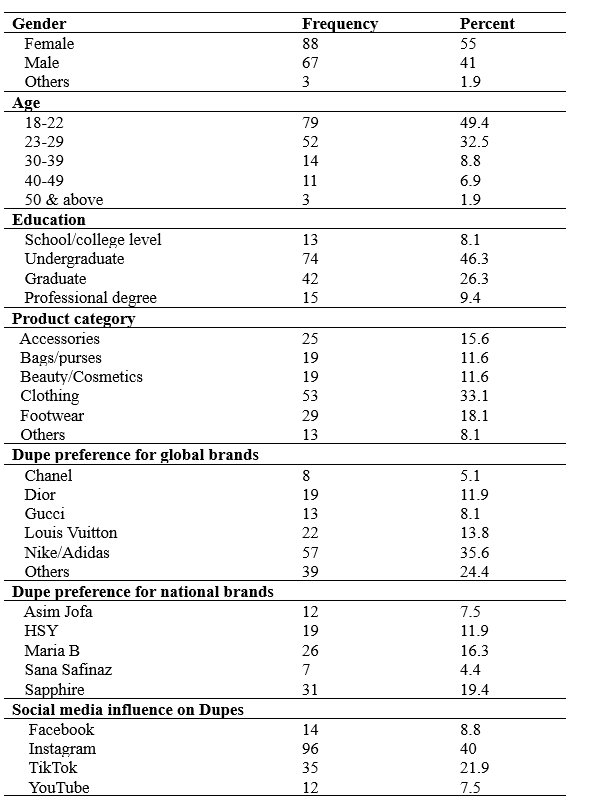
Table 1 presents the sample, which consisted of 150 participants pre-qualified based on their experience purchasing counterfeit or replica products. Of the total sample, 55% were female and 41.9% male. Consumer preference for dupe products was highest in the following categories: clothing (33.1%), footwear (18.1%), accessories (15.6%), bags (11.6%), beauty products (11.6%), and others (8.1%). Among national dupe brands, the most preferred were Sapphire (19.4%), Maria B. (16.3%), and HSY (11.9%). For international dupe brands, the top choices were Nike/Adidas (35.6%), Louis Vuitton (13.8%), and Dior (11.9%). To explore the relationships between variables and to assess the reliability and validity of the measurement model, statistical analyses were conducted using SmartPLS 4 software.
Measurement Model
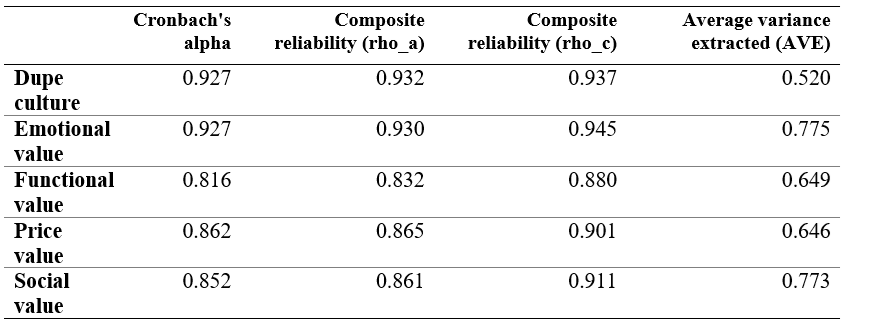
For reflective indicator loadings, to measure the internal consistency and reliability, convergent validity, and discriminant validity are used. The outer measurement model in smart PLS4 determines how well the questions load on relevant constructs which is shown in table 2. It shows internal consistency (Cronbach’s alpha and composite reliability) and convergent validity (average variance extracted (AVE). All factors loadings are higher than the thresholds level of 0.70 which is the minimum recommended by Hair et al. (2019).Composite reliability (rho_c) measures the internal consistency of a construct by taking into account the shared variance among items and indicates that items are closely related and measure the same underlying construct.
The threshold for composite reliability is minimum 0.7 or higher. Further, discriminant validity is measured through average variance extract (AVE) and it should be ≥ 0.05. AVE is used to validate a construct by measuring the amount of variance captured by a construct in relation to the amount of variance due to measurement error. All constructs’ AVE values are greater than 0.05 which proves their validity.
Discriminant validity also known as divergent validity is measured through Fornell and Larcker Criteria using the rule of thumb, if the square root of the AVE for each of the latent variables is higher than the highest correlation with any other latent variable, then discriminant validity is established. All the latent constructs explain higher variance of their own indicator than the variance of other latent constructs. Thus, the square root of each construct’s AVE has higher value than the correlations with other latent constructs as shown in table 3.
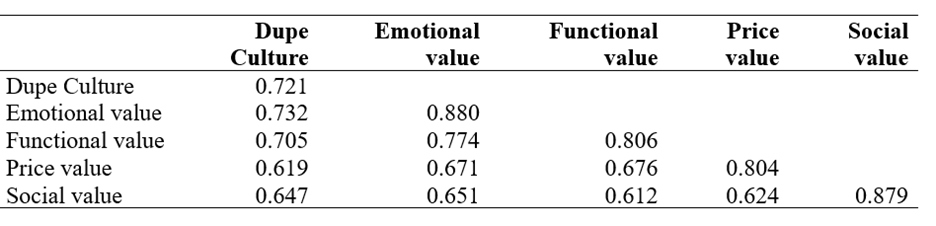
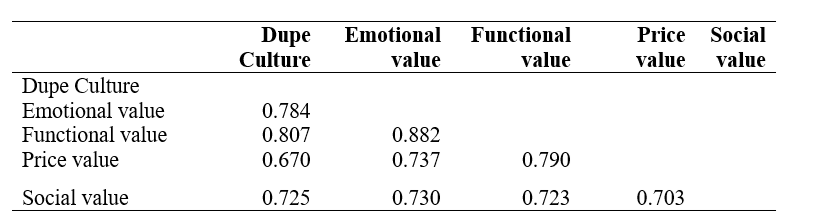
Table 4 presents the Heterotrait-Monotrait ratio (HTMT), an additional measure of discriminant validity that offers a more sensitive assessment of construct distinctiveness. According to established guidelines, HTMT values should be below 0.85; values approaching 1 suggest a lack of discriminant validity. In this study, all HTMT values for the measured constructs are below the recommended threshold, thereby confirming the presence of discriminant validity across constructs.
Further, model fit measures such as Standardized Root Mean Square Residual(SRMR) and Normed Fit Index (NFI) were analyzed in the outcome of PLS-SEM model estimation, SRMR transforms sample covariance matrix and predicted covariance matrix into correlation matrices and threshold value less than 0.10 or of 0.08 (Hu & Bentler, 1999) are considered a good fit. SRMR value in our model was reported 0.107 which is less than the threshold and shows model fit. NFI computes Chi² value of the proposed model and compares it against the benchmark or yardstick of the null model. NFI values range from 0 to 1 and values closer to 1 shows better the fit. NFI value in the estimated model was 0.710 which shows model fit.
Structural Model Results
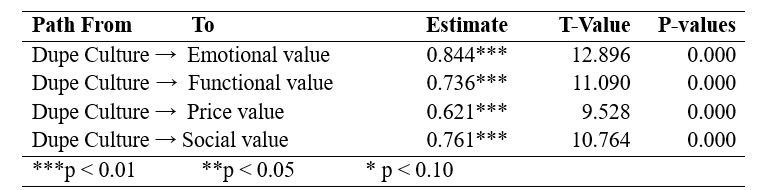
Figure 1 illustrates the results of the path analysis, which applies multiple linear regression to predict causal relationships among variables. The path estimates indicate that dupe culture and counterfeit products have a statistically significant impact on Customer Perceived Value (CPV). All four hypotheses are supported, as p-values are below 0.05 and t-values exceed the critical value of 1.96 for all constructs.
Among the constructs, emotional value exhibits the highest path coefficient (β = 0.844, p < 0.001), followed by social value (β = 0.761, p < 0.001), functional value (β = 0.736, p < 0.001), and price value (β = 0.621, p < 0.001), respectively. These findings suggest that consumers place greater importance on emotional and social dimensions than on quality and price when purchasing counterfeit products.
Additionally, ANOVA results confirmed that all regression models were statistically significant (p < 0.001), reinforcing the existence of meaningful relationships between dupe culture and each dimension of perceived value.
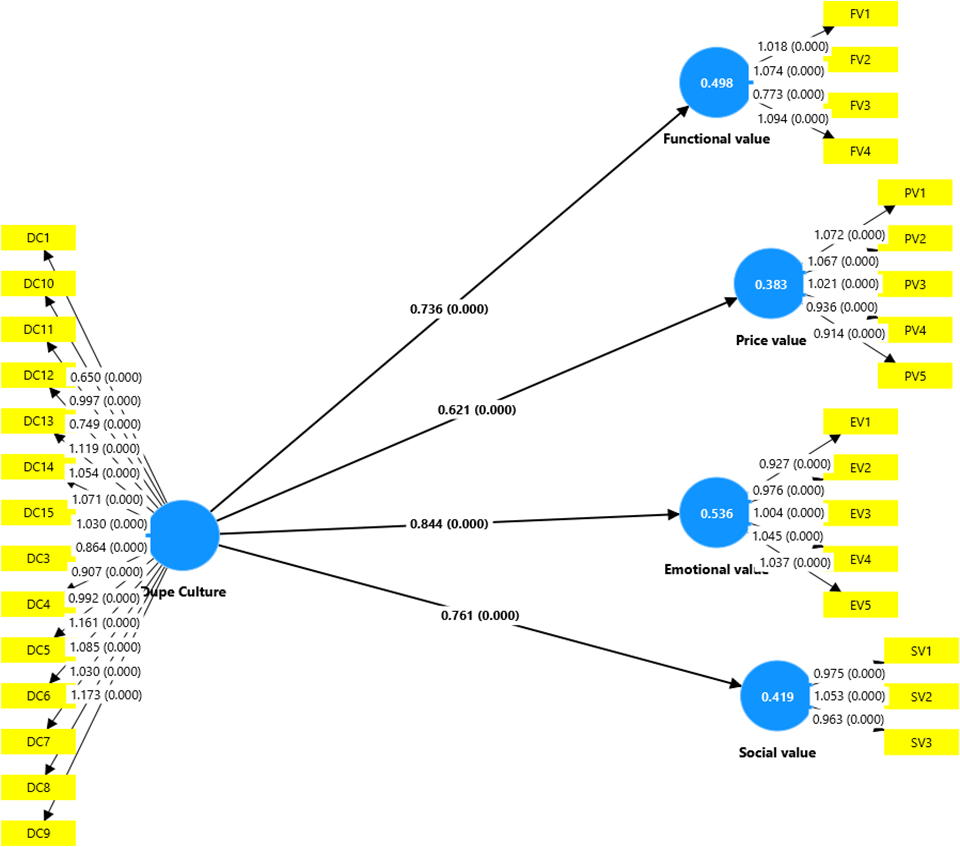
Table 5 presents the regression results, offering deeper insights into the predictive power of dupe culture on each dimension of Customer Perceived Value (CPV). Among the constructs, emotional value demonstrated the highest explanatory power, with an R-squared value of 0.536, indicating that dupe culture accounts for approximately 53.6% of the variance in emotional value. Social value followed with an R² of 0.419, and quality also showed strong predictive relevance with an R² of 0.498. In contrast, price value had the lowest R-squared value at 0.383, suggesting that additional factors-such as broader market conditions or economic influences-may have a greater impact on consumers’ price perceptions than dupe culture alone.
Findings reveal that emotional value is strongly associated with counterfeit consumption and the experience gives customers pleasures, joy, positive feelings and relaxing. Consumer’s associate social value with dupe consumption in the second order to feel acceptable, seek social approval, improve self-perception as well as make a good impression on others. Emotional and social values improve consumer’s self-image and status in society. Functional value emerged as the third important component of consumer perceived value (CPV) where consumers expect acceptable quality standards, consistent quality, consistency in quality, craftsmanship and performance.
It is pretty obvious counterfeits or replicas can’t offer high quality standard and craftsmanship as compared to original products and customer expectations in this regard are not so high as in case of emotional and social value. Although price or economic value is not the primary motivation for counterfeit purchase. Counterfeiting consumption in the context of Pakistan is more pleasured-based and status-based than concerns for quality and economic value. Pakistan is a power distance society where individuals have a higher need for individuality, status and power to impress others. Buying counterfeits for emotional and social norms make economic value less significant.
Discussion
Dupe culture is happening everywhere and has become an undeniable phenomenon. Dups products are more openly accepted by consumers and its becoming celebrated norms for luxury items. Research also points to the negative impact of perceived social risk on purchase intentions of luxury counterfeits (Wu & Zhao, 2021). Luxury products companies are seeking strategies to reduce the purchase intention of counterfeits. Some researchers argue that counterfeit consumption is the answer to address income inequality (Liu et al., 2024). In a developing country like Pakistan, consumption of counterfeits does not really harm the morality of an individual which less likely reduces purchase intention of counterfeits. Counterfeits hold a positive attitude in the society influencing consumer purchase intentions.
The popularity of non-deceptive (replicas/first copy) has skyrocketed in Asian countries where youth have strong desire differentiation and social approval. Consumer willingness to buy counterfeits is mainly governed by value consciousness where cheaper prices drive the decision. Consumer knowledge, concern and attitude towards counterfeit products influence the intent to pay premium price(Marcketti & Shelley, 2009). Price value and functional (quality) value were positively associated with counterfeits products consumption but with lower significance as compared to emotional and social values.
However, counterfeiting drivers in Pakistan appear to be little different where value consciousness, value for money and affordability are not strong predictors of counterfeit purchase. While price or economic value (ECV) is the primary motivation for counterfeiting in India (Samaddar & Gandhi, 2022) which is contrary to our findings. The reason why Pakistani consumers are less concerned for economic value, because of sample characteristics and participants selected from two private universities in Lahore represented a higher income class.
Although economic value is not a top motivation but is a significant factor when buying dupe of luxury products. Other studies also prove that economic benefits increase consumer desire for buying counterfeit luxury brands in emerging markets (Chand & Fei, 2021). Economic perspective remains an important factor for those customers who are price sensitive and seek value when choosing counterfeits.
The study result further shows social (prestige benefits, public-self) and psychological consequences (self-conscious, pleasure, joy identity) are primary motivations in counterfeiting purchase of luxury brands in - Pakistan. Middle class have a high aspiration for luxury lifestyle and therefore value emotional and social values. Pakistan used to be a low indulgence society (Hofstede, 2011) due to religious and other socio-cultural factors, but the young generation’s modern lifestyle has resulted in ever increasing demand for Western luxury brands.
Previous studies also prove that counterfeits consumption relies on emotional and symbolic values(Bian & Moutinho, 2011).Luxury counterfeits signal prestige image which makes buyers choose socially discernible luxury goods(Chen et al., 2015). Counterfeit buying for generation- z in Pakistan is no longer tied to quality and affordability but greatly captured by emotional and social values. Higher price value is not the primary motivation to choose counterfeit luxury products. Emotional value and need for social status dominates the luxury counterfeits purchase over cost-effectiveness (price value) and functional value.
Study findings reveal that utility and price are least desirable attributes associated with buying counterfeit products. Previous researchers have demonstrated that consumers try to maximize utility when buying counterfeits (Tang et al., 2014) which is little contrary to our research findings. Utility and price are related factors which appeals to young consumers who have a higher need for social recognition but lower affordability (Arli et al., 2020). Utility or functionality value captures consistency, acceptable quality, functional performance and craftsmanship. Literature also suggests that consumers have developed favorable perceptions of counterfeit quality over the years (Wilcox et al., 2009). Functional value or utility being the third most important factor in counterfeit buying highlights consumers attach the variable to counterfeit choice.
Previous researchers have recognized the significance of emotional and personal values from buying counterfeits products. Counterfeit luxury goods contain symbolic benefits that allow consumers to express a prestigious social image and construct identity(Perez et al., 2010). Other benefits include novelty value (Pueschel et al., 2020); and positive self-image(Perez et al., 2010).
Counterfeit product experience offers fun, enjoyment, thrill, feeling of being smart, savvy, positive self-image and construct identity. Previous studies also report the positive influence of self enhancement and discrepancy value (difference between one’s actual and ideal self) in shaping behavior towards counterfeit products (Shan et al., 2022). Purchase intention towards counterfeit products is mediated when there is need for self enhancement (social desire).
This is due to the fact that consumers understand it is not possible to have craftsmanship quality and artistic value from counterfeits as compared to original brands. Consumers understand counterfeit products can imitate the quality and artistic value of original luxury brands which in turn affects the price value and cost effectiveness of counterfeit products. Affordability and quality value propositions of counterfeits are less attractive than psychological and social value for buying luxury counterfeits in Pakistan. Customers believe that buying luxury counterfeits conveys an impression of nobility, high symbolic value and prestige social status. Counterfeits look similar to original luxury products and compensate consumers in terms of psychological and social benefits. Luxury counterfeits give consumers a unique identity in the public and it’s hard for the public to differentiate between replicas and original products.
This explains widespread acceptance of dupe’s culture in Pakistan is driven by emotional value and social status desire. It allows customers to fulfil their need for uniqueness, individuality, and social status. The dominance of counterfeits products negatively influence the perceived quality of authentic fashion luxury brands for Americans but not Asian consumers (Song et al., 2021).Perceived quality mediates the effects of counterfeiting on purchase intentions of luxury brands. Previous literature explored the significant impact of emotional value surrounding the ownership and purchase of dups products(Penz & Stoettinger, 2012). Emotional aspects are important drivers for purchasing dupes of luxury products. The findings reveal that dupe culture significantly influences CPV across all dimensions, with emotional value benefiting the most. Consumers associate dupes with emotional satisfaction, social status, and acceptable quality, despite recognizing limitations in price-related perceptions. These results suggest that dupe culture resonates deeply on psychological and social level, making it a critical consideration for businesses aiming to understand and cater to this consumer segment.
Counterfeiting has proliferated socio-economic, ethical and legal issues in emerging economies. For example, buying counterfeit of luxury is associated with a higher level of consumer regret and consumers tends to avoid counterfeit luxury product that does have a logo(Chen et al., 2015). Hence, counterfeiting proves to be a major factor giving rise to ethical issues and illegal trade in emerging economies (Chand & Fei, 2021).
However, literature suggest that consumers do not feel guilty and legally accountable for buying counterfeits of original brands at domestic level consumption (Phau & Teah, 2009b). So buying counterfeits is perfectly fine for consumers and does not harm their social, moral and legal sense of responsibility. Consumer may rationalize the purchase by shifting burden on the seller because of higher prices and non-availability of original products. So basically, consumer believes buying counterfeits is not illegal or unethical rather its counterfeit manufacturer. Researcher also argue that counterfeit consumption could be function of hostility or resentment towards luxury brands that promotes elitism (Loureiro et al., 2020). Moreover, piracy and copying culture is popular in Pakistan which give reasonable justification for buying counterfeit products.
Conclusions
The phenomenon of dupe culture has emerged as a significant driver of consumer behavior, especially in regions like Pakistan, where socio-economic dynamics, cultural norms, and digital influences converge to shape purchasing decisions. This study explored the intricate relationship between dupe culture and consumer perceived value (CPV), emphasizing the role of emotional, social, functional and economic factors. A critical finding from this review is the prominence of emotional value as the strongest factor influencing consumer engagement with dupes. Emotional value stems from the psychological satisfaction of appearing affluent, achieving social recognition and circumventing traditional cost barriers associated with luxury goods. Consumers derive pleasure from beating the system and this satisfaction outweighs ethical authenticity concerns for many individuals. The interplay between emotional and social values is particularly potent in Pakistan’s culture, where societal pressures and appearances hold considerable weight.
Consumers often prioritize maintaining a high-status image, even if it requires substituting authenticity with imitation. Ultimately the findings of this study call for a deeper understanding of consumer psychology in the context of dupe culture, with a particular focus on leveraging emotional value to navigate the challenges and opportunities posed by this evolving consumer phenomenon. Youth in Pakistan drives high emotional and social value from purchasing dupes (replicas, counterfeits), while functional quality and low price remain comparatively less significant variables. Consumer acceptability of counterfeit products t is a challenge to luxury brands manufacturer and can reduce the value of original products.

