




 Inglés (pdf)
 Articulo en XML
 Referencias del artículo
 Traducción automática
 Enviar articulo por email
 Citado por SciELO
  Similares en
SciELO
Similares en
SciELO 
 Permalink

Introduction
In this era of advanced technology, the entertainment industry has changed due to easy access to mobile, laptops, and the internet. These technologies bring entertainment to our fingertips and make our humdrum lives better. Particularly, young consumers are more induced toward these technologies due to economic plans and emerging technologies. Although, several modes are available for entertainment, however, Over-the-top (OTT) is gaining more attention among young consumers as it provides wireless services and audiences can access these services anywhere.
OTT platform is the term used to describe online streaming mediums (Chakraborty et al., 2023). These mediums include online channels and streaming apps that provide content ranging from movies, talk shows, and documentaries, etc., (Pandey, 2022). Though there exists fierce competition between these streaming giants, their origin is dated from the early 2000s when the IT revolution boomed, and the industry convergence was new to witness (Jain, 2021). YouTube is also considered an OTT platform, yet its ease of use, usage status, and breadth may leave a void for separate apps that specifically deal in unique and personalized movie experiences.
In this regard nearly, out of over 20 OTT streaming platforms, Netflix, Prime Video, and Disney Hotstar top as some of the established movie streaming apps whereas Netflix can simply be considered as a benchmark and may enjoy the status of a service that is popular among the masses. It won’t be wrong to comment on it being a first-mover advantage in marketing terminology. Netflix initiated its services as a movie rental store in the early 90s, which kept on evolving its business model over some time, and while capitalizing on its strengths and exploiting the opportunities, Netflix in 2007 initiated its operations as an online subscription-based model (Sadana & Sharma, 2021) and now into producing its own movies, series, and TV shows to sustain its competitive advantage. Another major players Prime Video, Apple TV+, ZEE 5, Disney+, Hotstar, Eros Now, and Paramount to name a few making the market competitive and having their respective market share.
However, customers of these mediums are confused about buying due to celebrity involvement, new releases, and prices. These are major factors that affect the purchase intentions of customers. People want to see their favorite celebrities and, from time to time new releases at economical prices. Furthermore, the quality of content also helps to purchase these OTTs, as customers might put content quality as one of their priorities. Therefore, based on the gratification theory this study analyzes the effect of celebrity, price, and new releases of the movies on customers’ purchase intention. In addition, this study develops the underlying mechanism to understand how these factors affect purchase intention through the intervening role of content quality.
So the objectives of the study comprise to analyze the impact of Celebrities’ movies on Purchase decisions of OTT platforms; to overview the role of price on consumer decision-making in the field of OTT, and to identify scope for new and quality content as value creation in OTT platforms.
Porter Five Forces
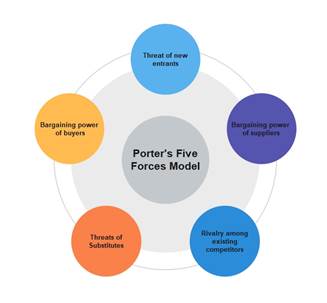
Michael Porter in 1979 discusses the influence of factors on industry competitiveness which is known as Porter's five forces (Porter, 2008). As per the model I the figure 1, the five forces encompass: 1) the Bargaining Power of the Buyer 2) the Bargaining Power of the Supplier 3) the Threat of substitutes 4) the Threat of New entrants 5) Competitive Rivalry among firms (Dobbs, 2014). Starting with the Bargaining power of buyers, in the case of OTT platforms buyers account for subscribers, users, and customers of OTT platforms. As for the current marketing trends, their bargaining power is considered high because of the forthcoming factors.
Source.Adelakun (2020)
First, it is the ease of switching to other platforms where monetarily and technological shifts are not complicated. It's just a matter of APP installation and entering the account details that can make customers switch to other available OTT apps (Juliana & Nyoman, 2019). Therefore, it can be stated that for OTT platforms it becomes significant to put buyers in the forefront and their choices and feedback be respected as their bargaining power is on the higher side. The next factor in Porter's model is the bargaining power of suppliers. This represents business-to-business cooperation and relations within firms and logistics (Rice, 2010).
In the case of OTT platforms, apps like Netflix, Amazon, Disney Hotstar, etc., are considered the customers of app developers and production houses, etc. While the availability of IT consultants and software houses makes the situation competitive, backward integration is the phenomenon for OTT platforms which may reduce the bargaining power of buyers. In this regard, OTT platforms like Netflix and Amazon Prime are already having their own productions and filmmaking procedures thus reducing their dependability on suppliers and other filmmakers.
Next in line could be the “threat of substitutes”. This entails fierce competition among OTT platforms, as it gives viewers an option to choose among the best. While the three major players could easily be Netflix, Amazon Prime, and Disney Hotstar, there are many emerging apps in OTT platforms (Dobbs, 2014) thus making the sector perfect competition.
Discussing the implication of perfect competition here, customers based on substitutes can switch to other OTT platforms e.g., from Netflix to Prime Video if there are observed differences in price, content, and other value-added services ranging from screen sharing to app infrastructure and other programs. And to make customers loyal, these OTT platforms may have a lot to do. For instance, Netflix in the latest past introduced a section of video games for kids. Similarly, bidding for new releases and blockbuster movies, hiring celebrities like Arnold Schwarzenegger, etc., as head action genre section (Morris, 2022) are some of the critical success factors that Netflix propels to cash on to stay ahead of the competition.
It will be interesting to analyze in the results section of this research if CSFs (Critical Success Factors) like these contribute to consumer purchase intention or in our research it can be termed as subscription intention. Number 4 in Porter's Five Force model accounts for the “threat of new entrants” (Karagiannopoulos et al., 2005). With the kind of business and convergence of the IT industry in almost every other field, this threat is considered on the higher side as well.
However, a lot depends on established players like the ones mentioned in this study and how they tackle and respond to that. For conventional businesses, economies of scale and horizontal integration (mergers and acquisitions) are some of the practices being employed by established businesses to counter this threat (Adelakun, 2020), though in the case of OTT platforms, collaboration with established celebs, alliances with benchmark production houses, use of innovative technologies backed by financial leverages, and in the worst case of huge competition promotions and discounts on packages could be some of the strategies that can aid to counter the threat of new entrants. Last, of course, the crux of the entire four factors is the ‘competitive rivalry” which may be termed as the outcome of all other factors (Rice, 2022). This rivalry makes the competition fierce if other forces are on the higher side. As per the ongoing discussion, the competitive rivalry in the OTT sector is quite high though in coming years before the field gets saturated.
Celebrity Brand
Celebrity branding is a well-researched concept in marketing literature. Celebrity branding must not be mixed with the brand ambassador as the latter talks about promoting a brand via a specific celebrity (Dwivedi et al., 2015), whereas the former focuses on considering/developing of celebrity as a brand him/herself. As per Kotler (2012) persons can be marketed as well, and once the celebrity being such a person turns out to be highly influential, it becomes a brand itself. Global celebrities like Shahrukh Khan in showbiz (Raj et al., 2016), and Christiano Ronaldo in soccer (Au-Yong-Oliveira et al., 2017), etc., are some examples of celebrities as a brand.
Once these celebrities become brands, their liking and charm appeal to their followers. Limiting our discussion to showbiz only there exist quite a few celebrities that encompass global appeal and this appeal is something that OTT might exploit to the must (Lestari & Wahyono, 2021). Arnold Schwarzenegger being a renowned action hero possesses his following up to Gen Y (Williams, 2012), similarly, movies of Tom Cruise can appeal to their respective audiences. So, when OTT makes a movie with these stars it looks highly probable that the respective followers might subscribe to watch their icons. As, the power of celebrity branding has been evident in the works of (Pradhan et al., 2016), applying the same phenomenon and their impact on OTT buyer behavior could be a significant contribution as well. This leads to the hypothesis 1 of the study as
H1: Celebrity branding has a significant impact on the OTT platform’s purchase intention.
New Releases
For moviegoers, the excitement for the new release of the film is always awaited (Sharma et al., 2023). Especially with OTT platforms, the choice has multiplied with what it used to be with traditional mediums (Joseph, 2024). New releases keep audiences connected with respective platforms is a phenomenon to be analyzed in this ever-emerging field. OTT platforms produce their shows (seasons) and create considerable hype along with the respective genre - thus making the audience wait for the next season (Singh et al., 2024).
This may be considered a great strategy for audience/ customer retention, as it keeps the audience waiting as to how the story unfolds or how the same theme will be picturized for another scenario/ situation. For example, a season encompassing a detective theme in York City will further be continued as the new season with the same detective theme in Berlin. This is a catch of new release that entails viewers’ interest thus satisfying the definition of marketing management in terms of keeping and growing customers.
Not limited to shows only, OTTs financial capability aided by their brand strength gives them leverage to produce feature films, documentaries, and talk shows thus aiding the cause of new releases in the further domain (Gupta, 2022). So, agreeing upon, the implication of new releases could be decisive for OTTs as this research proceeds further. The theoretical underpinning in line with the effectiveness of new releases lead to the formulation of the following hypothesis of the study i.e.,
H2: New release of movies affect OTT platform’s subscriptions significantly.
Price
The effect of price on consumer buying behavior is a fact (Zhao et al., 2021). Be it the FMCG sector, a financial institution, the hospitality industry, or the hotel business, etc., the role of price is always determinantal (Yuan et al., 2019). Though high prices are often linked with products being premium (Singh & Pandey, 2015), customers always focus on value for money philosophy (Vermeer et al., 2010). In the case of OTT platforms, the prices are competitive as well. It is significant to identify how viewers as customers look at OTT pricing. What is value for money for customers in the case of OTT platform subscription and reciprocally how do companies respond to that?
Could some companies cash on user-friendliness, or are there OTT platforms aiming to charge high prices based on the content they deliver? As of now, OTT platforms correspond to pricing in terms of different user statuses. E,g, Netflix dissects the pricing in terms of Screen sharing, use on TV or Mobile, and pixel quality (Kweon & Kweon, 2021). Though the claim of pricing based on offering different content is yet to find its claim, OTTs offering variants in terms of usage is a continued practice (Morris, 2022). Therefore, it is important to figure out various possibilities for charging different prices in contrast to customers’ view of critical success factors (CSFs).
H3: Price affects OTT subscription in a negative way.
Content Quality
Content quality has always been a major concern in the showbiz industry. The greater the quality of the script, the higher the chances of the movie being successful (Yi & Wang, 2019). Though content is not the only factor for declaring a particular show a hit/blockbuster, customers have ended up debating about content as good or bad (Himes & Thompson, 2007). The content includes script writing, which further can be dissected into the storyline, dialogue monologs, and screenplay. Such is the credibility of the content that despite a movie turning out to be a box office disaster, its dialogue and screenplay are appreciated. Sometimes, it’s the content of movies that makes the movie a cult as time passes despite average box office numbers (Jancovich, 2003).
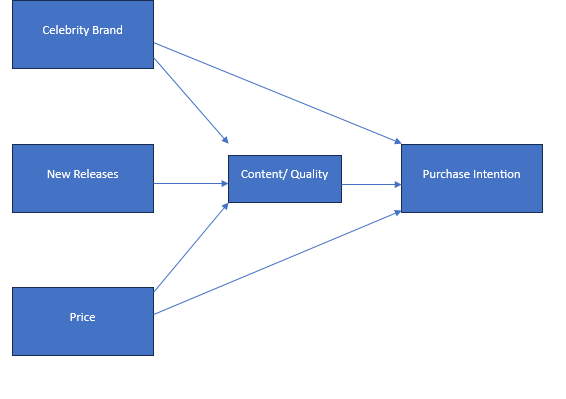
The figure 2 above proposes a conceptual framewok aiming at certain USPs for OTT platforms, content quality may be termed as one of the points of parity that these platforms should focus on to stay competitive. OTT platforms aim at seasons/ shows that should be engaging and generate positive word of mouth among their audience.
This further exemplifies the usage of subtitles where customers prefer watching movies from other regions based on the content. Therefore, regional content and cross-cultural productions are testaments of quality that might ensure customers a different content. Content being unique, and its diversity as a basis for pricing may be studied by developing the following hypothesis:
H4: Content Quality has an impact on customer purchase intention.
H5: Content Quality plays a mediating role between celebrity existence and purchase intention.
H6: Content Quality plays a mediating role between new releases and purchase intention.
H7: Content Quality plays a mediating role between price and purchase intention.
Methodology
Research design, sample, and data collection
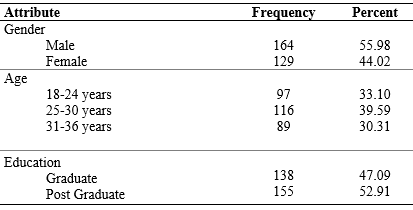
Around the globe, youth is more concomitant with technology and media. In this regard, this study targets university students who use OTT platforms and spend their maximum time on these platforms. We select students from the private universities of Punjab, Pakistan, as they have enough financial resources to afford these platforms. Due to the unknown population of OTT users, this study uses the convenience sampling technique. For this reason, 400 questionnaires were distributed to 18 different university students to achieve the minimum sample size. Based on the g-power formula, the minimum required sample size was 260. The total number of questionnaires returned by respondents was 307 and 293 questionnaires were completed in all respect. The demographics of respondents are presented in table 1.
Due to the cross-sectional nature of the study, there is a risk that the results may be impacted by common method bias (CMB) resulting from common method variance (CMV) (Harman, 1976). This may contribute to “correlational error” which refers to individuals responding variably that differ from the actual differences the constructs are meant to measure. It results when individuals continually answer the questions in different ways disregarding the actual variations in the constructs (Viswanathan, 2005).
To cope with CMV, we adopted both ex-ante and ex-post strategies. The ex-ante strategy included the following measures i) the respondents were asked to record fair answers while guaranteeing anonymity and confidentiality of recorded information (Podsakoff et al., 2003). ii) items of the survey instruments were shuffled while designing the questionnaire (Hameed et al., 2023; Murray et al., 2005). iii) we developed a sophisticated model at an early stage to avoid an interactive mental model (Harrison et al., 1996).
Subsequently, CMV was controlled using the ex-post technique. Harman's single factor test was applied which displayed 27% of variance (threshold value is 50%). Further, we applied CFA (confirmatory factor analysis) to the measurement model with a common latent factor (CLF) and without it (Hameed et al., 2012). Resultantly CFA was applied with and without CLF and the results of both the measurement models were fit. Now standard loadings were compared to investigate CMV. A variance of less than 0.2 percent has been observed which indicates that CMV is not present (Devonish, 2018).
Measures
A five-point Likert scale was utilized, with 1 denoting strongly disagree and 5 denoting strongly agree. The respondent's level of agreement or disagreement with a given statement was requested to be rated. Celebrity Branding was measured on the scale developed by Mann et al. (2023). This scale covers the celebrity’s influence on purchase intention. Items for New Releases were tailored and subjected to required validity and reliability tests, whereas items for Price were adapted from Curry (1985) and were measured by using the same 5-point Likert scale. The items for Content Quality were targeted to measure its moderation effect with other variables and were adapted from Moon et al. (2010), while some of the items were tailored by authors for adjustment with the topic. Lastly, the item scale for Purchase intention was taken from Young et al. (1998).
Results and discussion
The measurement model
In table 2, with the help of Smart PLS Version 4.0, the partial least squares structural equation modeling (PLS-SEM) technique was applied to analyze the measurement model. PLS-SEM enhances the dependent variables' capacity for prediction while allowing the constructs to hold more items (Azhar et al., 2024; Rehman et al., 2021). The PLS-SEM approach was applied because the normal distribution of the data is not needed in it, it is suitable for forecasting, and it can easily manage complex study frameworks (Albort-Morant & Ribeiro-Soriano, 2016; Rehman et al., 2023). Cronbach's alpha and composite reliability (CR) ratings were employed to evaluate the internal consistency of the constructs. Reliability was established because of the numbers above the 0.7 acceptable standards (Gefen et al., 2000). The convergent validity of the data was investigated by analyzing the measures' factor loadings and Average Variance Extracted (AVE) values (Fornell & Larcker, 1981). The loadings and AVE values were higher than the appropriate 0.7 and 0.5 cutoff values (Gliem & Gliem, 2003).
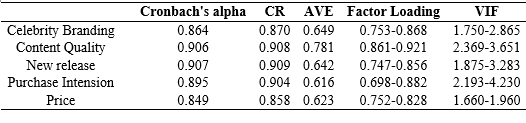
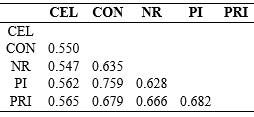
Then, discriminant validity was evaluated by Heterotrate-Monotrait Ratio. The value of HTMT should be less than 0.85 to show the discriminant validity among constructs. The results of the measurement model are presented in table 2 while Table 3 presents the HTMT ratio result to analyze the discriminant validity.
The Structural Model
After determining the results of the measurement model, we analyzed the research hypotheses by using the PSL-SEM technique. A total of seven hypotheses have been developed and the results revealed all of the hypotheses of this study have been supported. The results of these four direct relationships are presented in table 4 below.
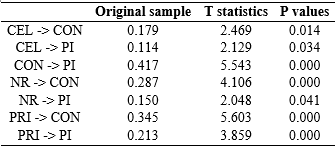
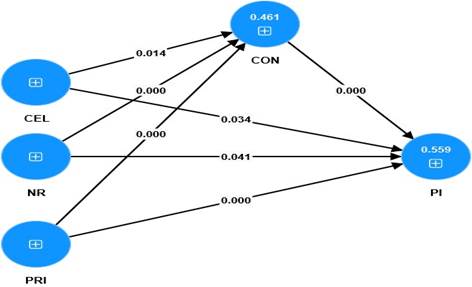
|In figure 3, CEL significantly influences CON and PI (β=0.179, p < 0.014), (β=0.114, p < 0.034) respectively. NR significantly positively influences CON and PI (β=0.287, p < 0.000), (β=0.150, p < 0.041) respectively. PRI significantly positively influences CON and PI (β=0.345, p < 0.000), (β=0.213, p < 0.000) respectively. Finally, the direct relationship between CON and PI is also positively significant (β=0.417, p < 0.000).
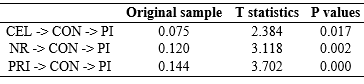
After that, specific indirect paths were analyzed, and the results present that CON significantly mediates the relationship between CEL, NR, PRI, and PI (β=0.075, p < 0.000), (β=0.120, p < 0.000), and (β=0.144, p < 0.000) respectively. The results are presented in table 5.
The results of this study show that celebrity branding significantly affects purchase intentions, as celebrities have personal inclinations, therefore, customers prefer to buy that OTT at which they have their favorite celebrity. Furthermore, as long the celebrity has good content then customers buy that OTT (Talwar et al., 2024; Verma & Yadav, 2023). Furthermore, new releases also have a positive impact on purchase intentions. New realeases attract and continuously engage customers. If the new releases have good content then customers are more likely to buy particular OTT (Soren & Chakraborty, 2023; Yoon & Kim, 2023).
This study has several theoretical and practical implications. For businesses of OTTs, the owners can consider these factors to attract more customers by fulfilling their needs and demands. They can focus on the content to increase purchase intentions. In addition, new realses help to engage more customers. On the other hand, customers can target the best OTT platform that provides good content, and favorite celebrities in an economical process. This study extends the gratifications theory by analyzing the mediating role of quality content, which helps the researchers to identify the different paths to explain the relation between celebrity branding, new releases, pricing, and purchase intention.
This study has a few limitations, as the target audience of this study is university students in Pakistan. Therefore future studies can target the other audience. In addition, this study has crossectional data, for future studies longitudinal data can be utilized for detailed results. Furthermore, this study identifies a few factors that can affect the purchase intention, other factors can also be pointed out with mediating and moderation effects.
Conclusions
Evident from the results that OTT platforms are a priority of customers and that certain factors contribute to customers’ preferences. The results depicting celebrity’s presence on OTT backed by quality content is an accepted norm in the showbiz sector. Being a renowned celebrity coupled with content quality makes viewers repeat customers (audience). Therefore, celebrities should focus on quality content as well, whereas OTT platforms should opt for better content. Producing big stars is one thing while a strong storyline could enhance user interaction and commitment to the respective platform.
The phenomenon of new releases also shows the positive commitment of the audience. OTT platforms should continue to add new releases to make customers excited about new serials, shows, and movies. This also entails less delay to new seasons of existing shows. Hit shows on platforms might result in customer engagement if their new seasons are announced, and customers might stick to their respective platforms to enjoy the new season. Again it should be ensured that the content quality of these sequels and prequels stays better than its previous version. The effect of new releases on customer choices has been supported in this study and accounts for a novel contribution to future studies. Though the price has always been a major decider for customers, in the case of OTT platforms it’s not the main factor as far as this study is concerned. This entails the room for the OTT market that the platforms might be of appeal to the masses. The prices are in range and it relates to the “Good value pricing” strategy i.e., customers perceive the product/ service being offered at a fair value in comparison to price. This ensures the scope for premium pricing while adding value-added features for multiple packages.
All in all, it can be said that the OTT market is a new means of entertainment accepted widely across the world, and it opens horizons for innovation and technological advancements while proposing new avenues of entertainment and business altogether.

