




 Inglés (pdf)
 Articulo en XML
 Referencias del artículo
 Traducción automática
 Enviar articulo por email
 Citado por SciELO
  Similares en
SciELO
Similares en
SciELO 
 Permalink

Introduction
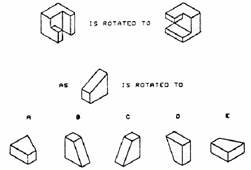
Spatial ability, defined as the capacity to mentally manipulate objects in three-dimensional space, is crucial for tasks such as mental rotation, spatial visualization, and perception. These abilities are essential for problem-solving, creative thinking, and reasoning, and widely researched in the field of cognitive science. One of the essential components of spatial cognition, the mental rotation ability which is assessed with mental rotation tests, is the focus of this study. These tests assess spatial visualization ability, specifically measuring the capacity to mentally manipulate 2D and 3D objects. The concept was introduced by Shepard and Metzler in 1971. Their work focused on how humans rotate objects in their minds to match perspectives and showed that mental rotation times increase with the degree of rotation required (Shepard and Metzler, 1971). Their proposed test (Figure 1) involves presenting participants with pairs of 3D geometric shapes, one of them being a rotated version of the other. Participants are asked to determine whether the shapes are identical or mirror images. After their work, several mental rotation tests were developed. In example, Vandenberg and Kuse MRT (Figure 2), is one of the widely used, involves 2D representations of 3D objects where participants select the correct rotated object from multiple choices (Vandenberg and Kuse, 1978). Another one is Purdue Spatial Visualization Test (Figure 3) which includes different components like rotation, object assembly, and perspective changes, often used in educational settings, especially in STEM disciplines (Sorby, 2009). Another one is Cube Comparison Test that presents cubes with different patterns on their faces. The participant must determine if two cubes are the same despite their different orientations (Hegarty and Waller, 2005). These tests differ in terms of the dimensions of the objects in question (2D vs. 3D), the complexity of rotations (e.g., one axis vs. multiple axes), and the cognitive processes they engage.
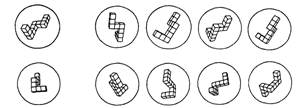
Source: Shepard and Metzler, (1971) and Vandenberg and Kuse, (1978)
Figure 1, 2: Examples from the Shepard and Metzler’ Mental Rotation Test on the left (examples from Vandenberg and Kuse’s MRT is on the right).
Assessing the spatial abilities through mental rotation tests is a topic of research also in educational domains, exploring whether education affects spatial abilities or whether spatial abilities influence school performance. In example, Zhu et al. (2023) emphasized that spatial ability training through STEM-relevant curricula not only enhances skills but also positively impacts academic performance in STEM (Science, Technology, Engineering, and Mathematics) subjects. Liben (2007) also stresses the importance of spatial thinking in educational curricula, suggesting that spatial skills can be developed through targeted interventions, especially in disciplines reliant on spatial reasoning.
Mental rotation ability and its relation to the education is also assessed through various studies. According to von Károlyi (2013), spatial skills, particularly mental rotation, are recognized as critical for success in STEM fields due to the need for visualizing complex structures and solving spatially-oriented problems. In a different context, Turgut (2015) studied prospective Turkish teachers to examine individual differences in mental rotation skills, considering factors such as academic performance, and preschool education. The author also found significant effects of academic performance and preschool education on mental rotation skills. This indicates that educational background, even from early childhood, can influence spatial cognitive abilities later in life. Moreau et al. (2010) also provide support for the developmental impact of academic training on mental rotation skills by comparing students in Bachelor of Sciences (BSc) and Bachelor of Arts (BA) programs. Their longitudinal study assessed mental rotation performance at the beginning and end of an academic year and found that students in the BSc program exhibited greater improvement than those in the BA program, suggesting that the academic content in science and technical fields plays a critical role in enhancing spatial abilities. Also, Vorstenbosch et al. (2013) found that medical students studying anatomy showed significant improvement in mental rotation test (MRT) scores, showing the relationship between spatially demanding subjects and the enhancement of spatial abilities.
In architectural education, spatial ability is an important skill required for tasks like understanding layouts, visualizing structures, and solving design- problems. Therefore, spatial ability research has also been conducted in the field of architecture. Yagmur-Kilimci (2010) explored individual differences in 3D mental visualization skills among architects and non-architects based on the performance in tasks that require visualizing a building in 3D based on its 2D drawing, whether this could be an architectural skill, and whether spatial visualization ability as measured by the paper folding test can predict performance in these 3D visualization tasks. With the non-architect group comprising mechanical engineers who can read architectural drawings, she concluded that 3D mental visualization skills, seems to become heightened in architects and they do not seem to be not related to spatial visualization ability. Akın (2003) evaluated the spatial reasoning skills of architecture students according to their years of study. The results showed that students in higher years encountered greater difficulty in solving spatial problems compared to their counterparts in lower years. However, an opposite result was shown in another study when the spatial task was domain specific. Berkowitz et al. (2021) conducted cross-sectional and longitudinal assessments of architecture students, finding that advanced students outperformed beginners in domain-specific spatial tasks such as perspective-taking and object composition. Arslan and Dazkır (2017) examined how novice students of interior architecture learn to visualize three-dimensional objects and spaces in their minds, how they improve their technical drawing abilities, and whether or not computer-generated and physical models help in the design process. Their findings show that the students' inability to produce 2D and 3D mental representations and to draw technically, had a detrimental effect on their creative process. Kara (2020) examined the contribution of a first-semester architectural course to students' spatial skills, observing significant progress in spatial visualization and perception, though no notable improvement in mental rotation. Mostafa and Mostafa (2010) investigated learning styles in architecture students and found that they show higher spatial abilities and tend to prefer visual and active learning styles compared to students from other disciplines. Also, Darwish et al. (2023) evaluated the impact of implementing XR in early architectural design education on students' spatial ability levels. Their results indicated that utilizing XR technology improves the participants’ spatial ability.
Several studies have also explored the connection between architectural education and visuo-spatial abilities through specifically mental rotation tests. Campos-Juanatey, Pérez-Fabello, and Campos (2017a) explored and compared the mental rotation skills of students from various academic disciplines, including architecture, fine arts, psychology, and business. Their research showed that architecture students outperformed their peers in mental rotation tasks, suggesting that architectural education, which emphasizes spatial skills, might contribute to higher performance in such tasks. In a study focused on architecture students' ability to rotate urban maps, Campos-Juanatey et al. (2017b) found that students' mental imagery skills, developed through their educational training, significantly influenced their performance in map rotation tasks. Architecture students performed better than business students in both the number of correct choices and the reduction of errors in map rotation. The study supports the idea that architectural education, which emphasizes spatial visualization and manipulation, enhances students' ability to process and rotate mental images. This is particularly relevant in practical tasks such as urban planning, where architects often need to mentally rotate and analyze complex spatial layouts.
Spatial perception studies have been conducted not only for three-dimensional space but also higher dimensions, specifically for the 4th dimension. Theoretically four-dimensional space is obtained by adding one more perpendicular axis to the existing 3 axes of the three-dimensional space (Hinton, 1880). Researchers have explored the human capacity to understand four-dimensional space despite our evolution in a three-dimensional world. Ambinder et al., (2009) demonstrated that people with basic geometric knowledge can make spatial judgments in four dimensions using virtual reality, even with minimal training and no feedback. Wang (2014) studied the potential for humans to perceive four-dimensional space through a spatial task involving hyper-volume, and asked participants to estimate the volumes of four-dimensional geometries. The results showed that people are capable of assessing four-dimensional spatial representations to a certain level. Miwa et al. (2017) have investigated whether people can develop four-dimensional spatial representations through perceptual experience with four-dimensional objects. They first taught participants about four-dimensional space and hypercubes, then asked them to complete tests assessing their perspective-taking, navigation, and mental spatial abilities in four-dimensional space. Likewise, the visualization and representation of the 4th dimension have been widely researched by mathematicians (Gardner, 1966).
The above studies have shown that it is possible to perceive the 4th dimension through its representations in lower dimensions. One of these representation methods is projection. Projection is a method frequently used by architects specifically when representing their designs through layouts through reducing the spatial existence of three-dimensional objects to two dimensions by reducing their coordinates in the 3rd dimension and representing them in two dimensions.
In line with this body of previous research, this study also focuses on the effect of architectural education on spatial abilities, based on the hypothesis that spatial ability is a modifiable skill through education, which is supported by the most of the previous research. However, unlike the previous research, this study explores how architectural education influences higher-dimensional spatial cognition, particularly in mental rotation tasks, by comparing architecture students with other department students and also with those from different educational backgrounds (STEM or non-STEM). The research questions are; (i) does the architectural education improve higher spatial perception and mental rotation ability, (ii) does the STEM education improve higher spatial perception and mental rotation ability, (iii) can a mental rotation test be proposed over representations of the same geometry in different dimensions.
The mental rotation test that is administered to participants in this study involved visually presented questions delivered online, aimed at assessing their perception of higher-dimensional geometries. Unlike mental rotation tests in other studies, the test questions were created with easier geometric visuals, and the aim was to evaluate performance by recognizing different appearances of a geometry across dimensions. Another specific thing about the test that is created for this study is, unlike the tests on the perception of higher-dimensional geometries in other studies, that participants did not receive prior training on higher-dimensional geometries before the test. The test is designed to enable participants to create analogies about the geometries in different dimensions that help them perceive higher dimensions while solving the test. In this regard, the test even has an educational aspect to it. In order to achieve this, the projections of nD cube are selected as the test questions, due to its easy to grasp geometry in different dimensions. The nD cube is the general name of the geometry that is a square in 2D, a cube in 3D, and a tesseract in 4D. The proposed test's combination of two-dimensional, three-dimensional and four-dimensional questions led to obtain comparative information on the spatial perception of the participants in these different dimensions. The study also provided information on the effectiveness of the proposed test and in what direction it should be improved.
In addition to comparing architecture students with several different BSc program students who received high school education in the same (STEM) curriculum, the range was kept wide for the participants who were subjected to the mental rotation test in order to guide future studies. The test was applied to students from other departments such as social sciences and language who weren’t exposed to STEM curriculum during high school education, as well as students from other departments within the faculty of architecture. The results showed the differences in four-dimensional spatial perception indicating the effects of both high school STEM curriculum and subsequent university education.
Methods
The ten-question test, designed to measure mental rotation skills, was made suitable for online participation via Google Forms and was delivered to participants within the scope of an individual project of a course in 2021 Spring Semester in Istanbul Technical University. 101 students, studying in different undergraduate departments of different universities in Türkiye and with an average age of 21.2, participated in the test. Apart from the mental rotation questions, the participants were also asked about their age, gender, university and department to classify the results.
Unlike previous studies, in this study, the participants were not informed about the fourth dimension and its geometry before the test and it was aimed that the participants learned dimensional analogies through questions during the test process. The geometry for the test is determined as nD cube, so that the participants could comprehend the analogies between spatial dimensions through the test. These analogies were expected to be easily grasped due to the geometric aspects of nD cube which has edges in each axis of the dimensions. In example, 2D cube (square) has edges on x and y axes, while 3D cube (cube) has edges on x, y and z axes, and 4D cube (tesseract) has edges on x, y, z and w axes. This purpose also affected the preparation of the test. In this test consisting of ten questions, the first question is two-dimensional visual rotation, the next three questions are three-dimensional visual rotation, and the next six questions are four-dimensional visual rotation questions. During the test, participants were expected to make mathematical and geometric analogies in order to understand spatial higher dimensions and find the correct answers by reasoning.
The visuals used on the questions were created via projection, focusing on edge lines, not surfaces. Participants were given a visual of the n-dimensional cube in question and asked which of the following two options could have been formed by rotating this geometry in its own dimension. Each of the ten questions was given 1 point and the test results were evaluated out of 10 points. While the questions are listed, first two-dimensional, then three-dimensional, and finally four-dimensional questions are included (Table 1).
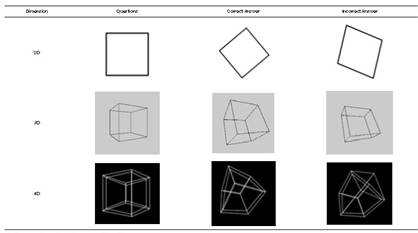
Processing application, a Java based visual programming IDE was used to create question visuals. The production, rotation and projection of two-dimensional and three-dimensional cubes (square and cube) were done by calling built-in functions in Processing. However, for creating a tesseract in the fourth dimension, rotating it in the four-dimensional space and projecting it on a two-dimensional plane, a computational tool developed in Processing was used (Akdoğan, 2019). This tool is a small program that allows the user to generate four-dimensional cubes, rotate them about any planes and project them onto the screen. A collection of images was created by rotating the four-dimensional cube in the fourth dimension and projecting them onto two-dimensional plane. Due to the structure of the n-dimensional cube, highly symmetrical and consistent representations are produced even when rotated in higher dimensions. Expecting that this consistency would be noticed by the participants, the visual representations obtained were used for questions and correct answers (Figure 4).

While creating the incorrect answers in the test, the corner points of the tesseract were changed on the computational tool and the four-dimensional cube structure with equal sides was deliberately distorted. This distortion also manifested itself to different degrees in the two-dimensional representations created by projection. Participants were expected to perceive these different levels of distortions in visual representations themselves and to be able to distinguish incorrect answers (Figure 5).

Source: Authors, 2024
Figure 5: Some of the projections of 4D cubes with the distorted ones, right and wrong answers respectively.
Participants were not given information about the fourth dimension before the test, nor were they informed about whether they got it correct or incorrect after each question, were able to see their results after completing and submitting the test. On the other hand, instead of seeing and answering the questions one by one, the participants were able to see all the questions on the same page.
After the test results were collected, the average scores were calculated and the obtained data were classified and compared according to the demographic and educational characteristics of the participants.
Results
Firstly, the average score of 101 participants who took the test was calculated and found to be 7,05 out of 10. The average answers received by all participants in the two-dimensional, three-dimensional and four-dimensional questions of the test were also calculated. Separate mean calculations for different dimension questions and the entire test were also made for differently classified participants. Among all participants, the results of male and female participants and the results of students from STEM and other departments were also examined comparatively (Table 2). Correct answer rates were calculated and compared according to the average scores received. The average score from one two-dimensional question was evaluated over 1 point, the average score from three three-dimensional questions was evaluated over 3 points, the average score from six four-dimensional questions was evaluated over 6 points, and finally the average score from ten mental rotation questions was evaluated over 10 points.

Then, the results of architecture faculty, social sciences students, and students of other STEM departments were examined comparatively (Table 3). Finally, this comparison was made specifically for 47 Istanbul Technical University (ITU) students among 101 people (Table 4). 14 of these participants are from different engineering faculties, 19 of them are from architecture major and 14 of them are from other architecture faculty programs including interior design, city regional planning, landscape architecture and industrial product design departments.


Before comparing the results and claiming that there is a significant difference, statistical tests especially hypothesis testing needs to be done. Testing a hypothesis is assessing, using sample data, whether the difference between the means is statistically significant or not. In this study in example, the alternative hypothesis (H1) asserts that architecture faculty students perform better than social science students, while the null hypothesis (H0) states that there is no difference in performance between the two groups of students. To ascertain whether there is sufficient evidence to reject the null hypothesis in favor of the alternative hypothesis, statistical tests would be used. Since the hypothesis testing is for the population mean and the number of samples is more than 30 (38 for architecture faculty students and 36 for social science students), “z test” needs to be applied (Table 3). With this test the aim is to prove whether the two means are from the same population. The likelihood that the two means have not been taken from the same population increases with the size of the z-score. Thus, the inference can be made that the samples' differences are statistically significant (Pearson, 1892).
The null hypothesis (H0) : μa = μs
The alternative hypothesis (H1) : μa ≠ μs
The significance level (α) is taken as 0,05.
Z = [ (x̄a - x̄s) - (μa - μs) ] / √[ ((Ϭa) 2 / na ) + ((Ϭs) 2 / ns ) ]
Z = (7,57 - 6,78) / √[ ((1,24) 2 / 38 ) + ((1,56) 2 / 36 ) ] = 2,40
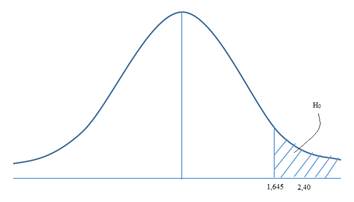
While the significance level of 0,05 is taken, Z score table is checked and the normal distribution curve is drawn with the value taken from Z score table which is 1,645 (Figure 6). This score gave the value ranges for H0 area which rejects the null hypothesis, which is shown as shaded under the curve. It is seen that the Z score is within the boundaries of H0 area. Thus, the Z score of 2,40 rejects the null hypothesis and the average of performance difference between two groups of students is statistically significant. P value is also calculated and found 0,0081 which shows high level of statistical significance (Pearson, 1892).
When making demographic comparisons, a comparison could only be made based on gender since the students' ages were very close. As a result of the average results of 101 students and their classification according to gender, it was seen that female students were ahead by 3% in two-dimensional and four-dimensional questions and by 2% in all questions, while male students were ahead by 2% in three-dimensional questions (Figure 7).
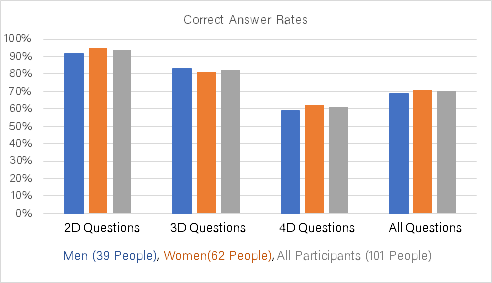
The performance of the participants in mental rotation questions in different dimensions can be read from Figure 7. Was achieved in the two-dimensional question and the correct answer rate of the participants was 94%. This was followed by three-dimensional questions with an 82% correct answer rate, and 61% correct answers were obtained in four-dimensional questions. The correct answer rate in the entire test was 70%.
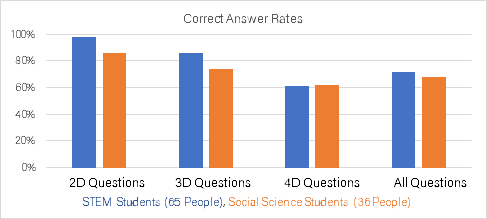
Then, the students were classified as STEM (architectural and engineering students), and social science students. The aim of this classification is to first separate students that took mathematical education during high school, then separate architecture faculty students from these, and finally compare students in architecture faculty (Figure 8). STEM students were generally more successful in this test with a difference of 4%. Moreover, they were ahead with a rate of 12% in two-dimensional and three-dimensional questions.
Source: Authors, 2024
Figure 8: Test results of students studying in STEM and social science departments
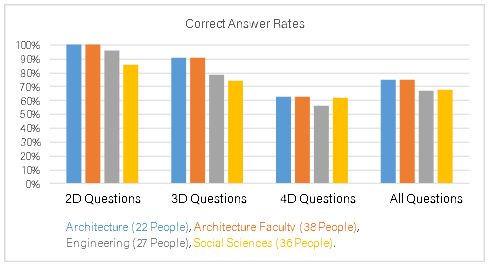
After comparing STEM and social science students, a comparison is made among 65 STEM students (Figure 9). STEM students are divided into three groups: architecture department students, architecture faculty students and various engineering departments. Among 38 architecture faculty students, 22 are from the architecture department and 16 are from the interior design, city regional planning, landscape architecture and industrial product design departments. The graph also includes the performance of social science students for comparison
Source: Authors, 2024
Figure 9: Results of students of the Department of Architecture and other departments
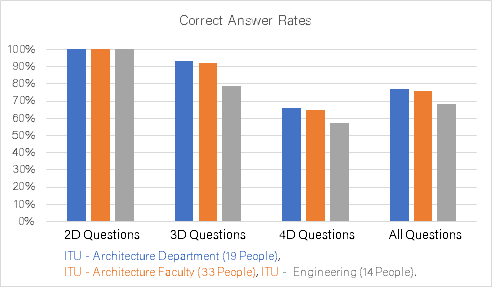
As seen in the graph, students of the architecture department and the faculty of architecture gave almost identical results and were seen to be ahead of other engineering departments. According to the test results, architecture department students are ahead of other STEM students with a rate of 4% in two-dimensional questions, 12% in three-dimensional questions, 7% in four-dimensional questions and 8% in the general evaluation of all questions. When the architecture department students are compared with social science department students, it is seen that they are ahead with a rate of 14% in two-dimensional questions and 17% in three-dimensional questions, while they are ahead with a rate of 1% in four-dimensional questions and the difference between them is quite reduced. It is seen that they are ahead with a rate of 7% in all questions. The same classification which made specifically for Istanbul Technical University students is graphed (Figure 10).
Source: Authors, 2024
Figure 10: Results of architecture department students and other STEM students in Istanbul Technical University
In this classification made specifically for Istanbul Technical University, it was seen that the students of the architecture department were ahead of the students of the faculty of architecture by a very small rate of 1%, but when compared to the students of other STEM departments, they were ahead. All students from Istanbul Technical University scored full marks on the two-dimensional questions. According to the test results, architecture department students are ahead of other STEM department students with a rate of 14% in three-dimensional questions, 9% in four-dimensional questions, and 9% in all questions.
In addition to these comparisons based on the classification of participants, it is also necessary to look at question-specific performance rates to determine the effectiveness of the test and the aspects that need improvement. When the correct-incorrect answer rates for all questions are examined, it is seen that two-dimensional mental rotation question has the highest correct answer rate (Figure 11). Three-dimensional mental rotation questions, follow the two-dimensional questions in terms of success rate. The success rate decreases in four-dimensional mental rotation questions. The questions asked and the correct-incorrect answers and the rates can be seen in Table 5.
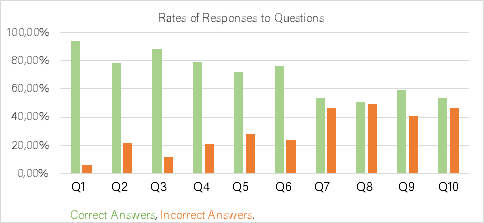

When the four-dimensional mental rotation questions are examined, it can be seen that the questions that can be most easily identified are the 5th and 6th questions in which participants showed a high success rate (72,3% and 76,2%) due to their high resemblance to 3D cube rotations. For the rest of the four-dimensional mental rotation questions, the participants encountered a visual that they were not familiar with and for which they were not informed before the test. Not training the participants about the four-dimensional space and geometries before the test was a decision in this study. Therefore the success rate is decreased due to both the inexperience in imagining the 4th dimension and the fact that the dimensional inconsistency in the incorrect answer was not very obvious. It is also possible to comment that four-dimensional questions, which cannot be answered with the accustomed mental rotation skill because they are unfamiliar, are solved by determining the incorrect answer instead of concentrating on finding the correct answer.
Discussion
Firstly, the proposed test must be evaluated in terms of its effectiveness. Participants were expected to learn and answer four-dimensional questions during the testing process without having any knowledge of the higher dimensions. The fact that the participants, who were not given any information before the test, achieved 60% accuracy in four-dimensional questions was considered a positive result in terms of the test structure. When the general mental rotation skill is evaluated, the participants showed 70% success in this 10-question test consisting of two-dimensional, three-dimensional and four-dimensional questions. The selection of nD cube representations in the test, which create consistent visuals even in two-dimensional representations with equal sides, also contributed to these results. On the other hand, a more comprehensive and broader test should be prepared to make a more accurate inference, taking into account the random answers of the participants.
Due to collecting separate data on two-dimensional, three-dimensional and four-dimensional mental rotation, skills in these different dimensions could also be compared. It is seen that STEM students’ performance was generally ahead of the social science students with its success in two-dimensional and three-dimensional questions, but this difference disappeared in four-dimensional questions and even STEM group fell behind the other group, albeit by a small margin. When the comparison of the performance of social science students and architecture students are made, it is seen that architecture department students are ahead by 14% in two-dimensional questions and 17% in three-dimensional questions, while they are ahead by 3% in four-dimensional questions and 8% in all questions. Outperforming in two-dimensional and three-dimensional questions can be explained by having a better command of geometry as required by the STEM curriculum. However, the fact that the difference is very small in four-dimensional questions is an unpredictable but encouraging outcome for further research. It can show that not only the abilities provided by STEM and architectural education but also other factors play a role in four-dimensional spatial perception and mental rotation skills. But it can also be explained by random answers given. This inconsistency shows the necessity for a more comprehensive and broader test to consider random answers and obtain more coherent results.
According to the results, the architecture department students outperformed the other groups not only in two-dimensional and three-dimensional questions, but also in four-dimensional questions. While the difference in success between architecture department students and other STEM students was 4% in two-dimensional questions, it reached 12% in three-dimensional questions and 9% in four-dimensional questions. In the general evaluation of all questions, architecture students are ahead of other STEM students by 9%. The same comparison was made specifically for Istanbul Technical University students and according to the test results, students of the architecture department were more successful than other STEM students with a rate of 14% in three-dimensional questions, 9% in four-dimensional questions and 9% in all questions. It may be possible to explain this difference reflected in the test by STEM students, who have the same high school curriculum, with the different education received at the university. Thinking in three-dimensional and representing it mostly in two-dimensional in architectural education, and familiarity with the projection method may explain this performance difference in three-dimensional questions. Better performance for four-dimensional mental rotation questions in the test results can be interpreted as the fact that architecture students are more inclined in representing higher dimensions in lower dimensions and recognizing them due to their university education than other STEM students in this study.
When the structure of the test and the test performance were examined, it is seen that the learning approach during the test process gave positive results and, as predicted, they were more successful in certain questions. Likewise, relatively low performance was shown in some four-dimensional visual questions where the testing process was insufficient to create familiarity and perception. However, the test needs to prove its competence through further research. First of all, tests should be performed with pre-test information to compare with the results obtained without pre-test information. For classifying the participants and evaluating their performance, more comprehensive results should be obtained. The participants from each class should be increased. More controlled experiments should be conducted to ensure that these participants can answer the questions under equal conditions. The outcomes of factors such as keeping time and setting time constraints, which were frequently used in previous studies, should be investigated. Another important issue to increase the proficiency of the test is to expand the question pool.
Conclusion
In this study the differences in visuospatial abilities among undergraduate students of different programs was investigated by considering the effect of previous high school curriculum and current university curriculum on these abilities. The study is conducted with 101 students, studying in different undergraduate departments of different universities in Türkiye and with an average age of 21,2 101 students consist of 65 STEM students (38 of them from architecture faculty, 27 of them from other STEM faculties), 36 social sciences students. The visual spatial abilities were measured by developing a series of mental rotation tasks that involves mental rotation of 2D, 3D and 4D cubes based on their 2D projections. The findings reveal that students from the architecture department outperformed their peers in two-dimensional, three-dimensional, and even four-dimensional mental rotation tasks, suggesting that architectural education, with its emphasis on spatial reasoning and projection methods, positively effects the developments of these skills. Also, the comparison between architecture students and STEM students suggests that architecture education provides unique training that enhances mental rotation abilities beyond the level typically observed in other STEM fields. The unexpected outcome, where the difference in performance between architecture and social science students narrowed in the four-dimensional tasks, points to potential external factors influencing higher-dimensional perception. This outcome needs further investigation to see what contributes to the development of mental rotation skills beyond traditional educational pathways. This also shows the necessity for a broader and more comprehensive test, as well as controlled experimental conditions, in order to more accurately assess the influence of random answers and improve the reliability of future results.
This study has other limitations that need to be addressed. First, the sample size, though useful for initial insights, was limited in scope. Expanding the participant pool across different universities, regions, and educational systems would provide more generalizable results. Another limitation is the absence of pre-test and post-test data. Without a baseline measurement, it is difficult to determine the extent to which architecture or STEM education specifically contributes to the development of spatial abilities. Future research could incorporate longitudinal studies that track changes in spatial skills over time, ideally beginning with incoming students and following them throughout their education. This would allow for more direct conclusions about the causal impact of different educational experiences.
Despite the limitations, differences in mental rotation performance across disciplines show the unique cognitive demands of architectural education, supporting the importance of spatial thinking in this field. This suggests that architectural education provides students with unique cognitive skills. In example, the ability to think in three dimensions and represent these ideas in two dimensions is fundamental to the design and visualization processes in architecture. Furthermore, the fact that architecture students also performed better in four-dimensional tasks, a more abstract and complex spatial challenge, shows the adaptability and depth of the spatial skills fostered by architectural education. It can be considered to integrate more explicit training in spatial visualization and mental rotation into architectural programs, as well as to create opportunities for students to engage with higher-dimensional thinking. This could better prepare architecture students to tackle the increasingly complex spatial problems they may encounter.
While this study focused on mental rotation tasks, future research could explore other forms of spatial thinking relevant to architecture and STEM, such as spatial visualization, spatial orientation, and perspective-taking. Additionally, exploring the role of technological tools, such as virtual reality and 3D modeling software, in enhancing spatial cognition could offer valuable insights for improving both education and practice.
In conclusion, this study contributed to the field with its novel test formation which includes higher dimensional geometries and urges participants to learn through the testing process with analogies and comparative analysis of students from different educational backgrounds, while helping to understand the role of education in developing spatial abilities, even higher dimensional abilities, particularly in relation to the complex tasks encountered in architectural and STEM fields.

