




 Inglés (pdf)
 Articulo en XML
 Referencias del artículo
 Traducción automática
 Enviar articulo por email
 Citado por SciELO
  Similares en
SciELO
Similares en
SciELO 
 Permalink

Introduction
The Latin American city is undergoing a process of increasing expansion and dispersion, which reveals a multiplicity of common features characterized by the emergence and fragmentary condition of its structures. This demonstrates the consolidation of a model fostered by the neoliberal shift of the 1980s and later by the urban primacy encouraged by the global city paradigm. This worldwide phenomenon, associated with the internalization of economic flows and greater degrees of freedom for private actors (real estate investors, economic and financial groups, etc.), has unique regional particularities: socio-economic inequality. Furthermore, the impacts produced by official planning, both in changes to land use regulations and the morphological parameters of urban growth, have highlighted the dynamics underlying these deregulation processes and the constant changes in the physical and functional structure of the territory (Borsdorf, 2003). In this regard, the theoretical frameworks of complexity sciences provide clarity on how economic and social inequality systematically influences reality, gradually denaturalizing the complementary relationships that social systems establish with their environment to structure their geographies in a balanced way. Considering that "the concept of structure presupposes that of the system" (Giddens, 2012, p. 18) - because only social systems possess structural properties due to the regularity with which they tie and reproduce their relationships - the analysis of the notion of structuration implies explaining "how structure is constituted by action and, reciprocally, how action is structurally constituted" (Giddens, 2012, p. 205).
The study begins with a general approach at the macro scale level that analyses both the content and form of disputes within the city system and the spatial structures resulting from differentiation processes outside its relational boundaries, shaped by the urban system as a complexifying domain. Generally, alterations to urban metabolism fall upon the peripheries, which have been denaturalized by official planning to the point of achieving their material and functional essentialization. This produces the state changes that the urban system needs to resume its transformations under the mechanism of fragmentation as the identity of its functioning. In this context, the hermeneutic-dialectic method, employed as a form of structural research, has allowed for the description of the structures and dynamic systems that account for the phenomenon of socio-spatial fragmentation. On the one hand, through a procedure of theoretical abstraction that enables dialogue with the different scales of urban reality, and, on the other hand, the incorporation of invariants that define the specificity of certain procedures beyond the type and location in the urban space. These methodological conditions have led to a series of findings, the main contribution of which is the construction of a general model of the functioning of the city system, complemented by a scheme of energy exchange between the system and its environment. This scheme has made it possible to visualize the form that urban metabolism takes in its centre-periphery relationship. From this, the existence of cycles and critical zones of state change emerges, where inequality-as a structural condition-functions as a subsidiary of the differences in energy intensity that the system requires for its evolution.
The overall perspective of the analysis is framed within current discussions about metropolization processes, particularly focusing on constructing a functional model that can be contrasted with the reality of the object as a non-exclusive approach. Starting from the presumption of the existence of open systems like the city, the socio-spatial fragmentation phenomenon has been problematized, where geographies interact systemically with the power of institutions, individual interests, and available materialities in constant disputes for the transformation and evolution of their spatialities. Metropolization is understood as a spatial model based on the extension, intensification, and materialization of flows of matter and energy in the territory.
These singular social practices, according to the particular characteristics of subjects, time, and space of the study period and area, entail a "code" in the form of causes (subjects, factors, and variables) that have determined the form, intensity, and direction of the metropolitanization process to be studied (Martínez Toro, 2015, p. 216).
Form, intensity, and direction constitute the conceptual triad on which the study of the city as a complex self-regulating system has been approached as an "integration and interaction of different, antagonistic, and complementary units" (Ruiz Sánchez, 2001, p. 7). In its study and conceptualization, both the mechanism for selecting material and non-material entities and the role they play in the process of organization, structuring, and evolution of the urban system are decisive.
The general theoretical framework addresses the phenomenon of socio-spatial fragmentation of the city from the perspective proposed by General Systems Theory (GST), which involves assuming the existence of nonlinear and unpredictable mechanisms in the production of spatial boundaries. These boundaries constantly encourage the expansion of urban space and respond to open processes in relation to their environment. This is equivalent to the way biological entities behave thermodynamically, where significant degrees of information and energy intensity-characteristics only attributable to living organisms-are determined for their evolution and perpetuation.
Like any open system that transforms and degrades energy in its exchange with the environment, the need for permanence is closely related to living beings in their process of growth and adaptation to their surroundings. However, in all cases-whether living or non-living systems-there are internal "laws" or "rules" that additionally control the way in which the consumed energy is managed. The construction of these storage structures is the same that will be used to produce future transformations and constitute the operational circumstances under which the urban system ensures its permanence over time.
Method
Using the hermeneutic-dialectic method and based on the theoretical framework provided by General Systems Theory (GST), the reality of urban metabolism in the Latin American city has been represented through the interpretation and schematization of the mechanisms under which the functioning of the urban system is structured. The explanations aimed to define a methodological pathway that moves from the abstraction of the systemic totality to the definition of a series of procedures that materialize the internal functional logic.
The first part of the analysis determines the different phases of urban coevolution as a result of complex differentiation processes in which organized forms of social, institutional, and technological relations operate mediated by meaning. An inherent characteristic of communication-based systems (direction and interests of disputed information). Finally, from understanding the parts, there has been a return to a reconstruction of the whole in an expanded manner through new schematizations that have allowed for testing other problematizations within the case study, supported by specific urban situations. The discourse is completed with conclusions on the main urban issues that repeat today, such as the dynamics of fragmentation between centre and periphery, the implications of inequality in the general identity of the system, or the emerging spatialities that impact new urban structures from the micro-scale.
Origin of concepts
The compilation of data preceding the task of theoretical reconstruction has drawn upon advancements historically made by General Systems Theory (TGS). In doing so, certain concepts and definitions developed by Ludwig Von Bertalanffy (1976) since 1925 have been incorporated. These include notions such as unit and identity, relational field or environment as inherent to all open systems. Finally, the concept of evolution contributed by thermodynamics serves as the functional basis for understanding the entirety of phenomena attributed to open systems in relation to their environment. Moreover, the evolutionary function allows us to comprehend how the flows of energy intensity are systematically organized to produce the material structures we inhabit. In line with Johansen Bertoglio's assertion (1993), both internal interactions within the system and external interactions with the environment enable "explanation of phenomena occurring in reality and also facilitate the prediction of future behaviour of that reality" (p. 13-14).
Prigogine's studies revolutionized thermodynamics in the 1960s by contradicting classical axioms that recognized only one possible outcome, either thermal equilibrium-from thermodynamics-or the fittest design-from Darwinism-affirming their validity only for closed systems where energy is always conserved. It was assumed beforehand that once equilibrium is reached, the system no longer needs a new evolutionary process to ensure its permanence over time (De Landa, 2011). In open systems, the energy process is different because internal equilibrium does not exist unless there is simultaneously an increase in the complexity of the environment. Von Foerster, building upon second-order cybernetics, advances the explanation of the conditions for existence and evolution of self-organizing systems, where "their order, by definition, is achieved through the disorder of the environment" (Ruiz Sánchez, 2001, p. 15). In this sense, the structures produced as part of the self-regulation process from a restrictive environment are the result of fluctuations or critical points that stimulate the creation of new states through the mechanism of differentiation.
Thus, the concept of autopoiesis introduced in the 1970s from biology by Maturana and Varela (1990) completes the theoretical circle of internal coevolution and external evolution as mechanisms that living systems possess to self-regulate from their environment: the production and organization of energy resources that produce their own elements and operations through the endogamy of their systemic functioning. The functional relationship among the concepts of autopoiesis, entropy, and complexity refers-in the analysis of current urban reality-to how both the social system (SS) and the technical system (ST), as (sub)systems within society, undertake complex processes of hybridization of available intensity flows: people and goods (for the former) and flows of capital, intensity of relationships, and decisions (for the latter).
3.Results
3.1.Functionality of the urban system: variables in context
Power struggles form the basis of every social system, where the most hegemonic (sub)system ensures its stability over time (permanence and identity) through a process of reducing uncertainties about the future. To achieve this evolutionary status, there must be a relational field whose elements and interactions are in a potential state of change, allowing the flows of intensity of their materialities to be redirected to generate new transformations. The differentiation action driven within the system is encouraged by the low restriction exerted by the environment due to its low material and formal complexity. Therefore, differentiation involves instances of intra-system sense disputes (city system) and forms of differentiation and development outside the system (urban system) with respect to the properties of the operating environment (Figure 1). As anticipated by Ruiz Sánchez (2001), it can be inferred that socio-spatial fragmentation-as a particular form of organization-is a direct consequence of assigning a "matrix of characteristics to each elementary unit of property" (p. 8). A functional matrix simultaneously articulates physical proximity and social distance.
Inequality manifested in the imbalance between physical and social components is a characteristic of the complexity in the spatial distribution of material and energy flows. It explains the systemic functioning of the city where property ends up being the value resulting from the process of functional differentiation between public and private spheres, individuals and the State, economic institutions and financial capital, official planning and real estate groups. Consequently, there is a hierarchy in the intensity of these flows based on "equally differentiated and progressively specialized spaces" (Ruiz Sánchez, 2001, p. 10).
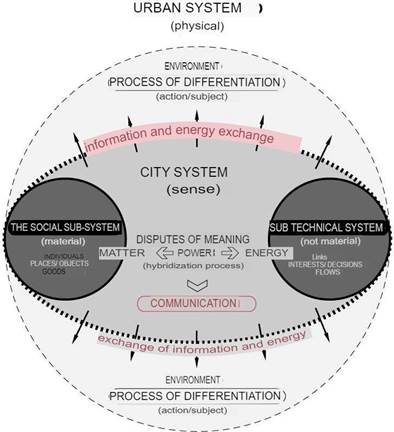
Source: Author (2024)
Figure 1: The components of the urban system in its systemic functioning logic.
From the above, it follows that the hierarchy of intensities decreases towards the periphery of the system, as central areas reserve the highest indices of urban diversity (old town and early expansions), ensuring their maintenance. In this sense, authors like Rueda (2022) and Mendiola (2017) associate the concept of urban diversity with urban complexity as necessary factors for the sustainability of the city system in the same centre > periphery direction based on plot size, building type, functional matrix associated with land uses, and accessibility (communication channels): higher density and compactness of urban fabrics lead to greater urban diversity and vice versa.
3.2.Phases of coevolution
In material and meaningful systems, the differentiation processes that have given rise to the existence of the city are sustained over time through existing material and relational structures. It is within the overlap of these structures that the potential for communication resides, which the system needs to ensure the set of decisions that enable continuity of transformations. For these maintenance and system continuity actions to be viable, it is necessary for the differences produced by the city system to have optimal communication channels in the environment.
The social system (SS) and the technical system (ST) redirect their interests among existing specialities through the production of power via hybrid channels of information between matter and energy, where capital plays a decisive role in separating and segregating environments and material components that, due to their accumulated memory, hinder the endowment of value.
The material systems (flows of matter and energy) and the systems of meaning (information) function in a mirrored manner with their environment, from which they are mutually reinforced through a series of procedures that can be summarized in the following chain of events:
3.2.1.
Intra-system communication: sense dispute
The existence of messages implies a communicative intention governed by rules that can only be differentiated when certain power struggles over meaning occur within the social system (Luhmann, 1992). This is the initial stage of the process where communicative actions useful for the system's purposes are resolved (Figure 2). Primarily, these involve flows of matter and energy that engage both the SS and the ST.

The first (left side of the graph) does so based on its interests anchored in the present, using communicative actions aimed at maintaining existing organizational states through the alignment of individual actions and available materialities. The second (right side of the graph) operates based on interests focused on the future, as the organizing power of capital flows is driven by hierarchies of value it generates and the likelihood of triggering state changes.
The probability of future organizational states that capital's fluidity engulfs requires relational structures opposite to the SS to generate the necessary uncertainty between action and materiality. This is achieved through physical and functional separation, creating inequalities among individuals, or by renewing and specializing existing materialities through the mechanism of urban intervention.
3.2.2.Production of differences: functional complementarity
Once the system has established its power structure, the initial intrasystem complexity (which enabled it to select possibilities) must embed its hybridization of matter and energy into the environment. This embedding occurs through the relationship of functional complementarity between hybrid formations of the social system (elements) and a conducive relational field (relationships), based on significant differentiation operations concerning their current properties (Figure 3). Both power and capital are sustained in line with their interests by normative structures such as urban code modifications, tax exemptions, etc. These measures allow them to reduce their systemic complexity, as "the acquisition of urban characteristics by each plot" (Ruiz Sánchez, 2001, p. 13) narrows the scope of selection and thus makes the exercise of power more operational.
The consolidation of this process is evident in numerous anticipatory strategies inherent to real estate speculation, such as controlling land and housing market prices, reserving spaces for intensive uses, etc.
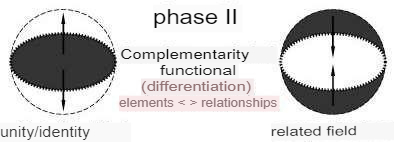
In the urban system, both plots of land and buildings are the primary objects of transformation (and speculation). Their regulation is conditioned by a set of rules (urban code) aimed primarily at organizing the material and relational structures extended in urban space (system environment). These rules control the temporal degradation of materialities and ultimately result from differentiation processes whose stratifying mechanism includes relationships of dominance and decision-making, namely property ownership. Additionally, the system ensures its identity through the order of environmental elements that function restrictively because individual expectations operate on them, transforming into collective expectations when the freedoms they enable allow individuals to interact with materialities.
In this sense, property as a mechanism must be topologically related to reconnect boundaries, densify flows, and complexify materialities: a process of hybridization between material entities (plots and buildings) and non-material entities (interests and decisions) whose connection is based on differential attributions of interest and value. This matrix of characteristics inherent in property serves the function of structural coupling of the social system with environmental structures (Luhmann, 1997) and conditions the interconnection of its boundaries (land use), the density of its flows (accessibility and scale of communication routes), and the complexity of its material structures (buildability and compactness of urban fabrics).
An example in the context of the city relates to the essentialization of functional characteristics carried out on urban land use conditions in areas where more dispersed and less complex structures predominate (monofunctionally). It is here that spaces and their relationships begin to show a decrease in material and energy intensities (reduced complexity), and where the system has greater potential to increase its entropy (re-organization) to stimulate the production of new differences. This process constitutes what we refer to as a state change.
3.2.3.Emerging spatialities: state change
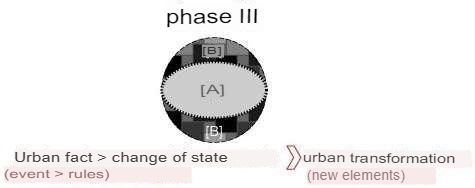
As mentioned earlier, the urban system evolves through the exchange of energy with stimuli from the environment. To achieve this, it needs to consume territory where space does not resist the transfer of energy. This occurs when the environment becomes homogeneous and essential, where material and energy consumption is unidirectional or guided by specialized communication channels, such as peripheral road systems or monofunctional commercial, industrial, or service corridors. While in one part of the system energy and matter are consumed, transformed, and complexified [A], at the other extreme of its systemic functioning, spatialities degrade [B] (Figure 4). These areas of state change are located between the degradation of compact city areas (central fabrics) and the renewal of zones where individual actions begin to diverge from available materialities (disarticulated peripheral fabrics), thereby facilitating the insertion of new rules for new hybrid entities.
This Critical Point of Energy Exchange (PCI) functionally defines the change of cycle of urban metabolism, where the consumption and transformation of land reflect the transition from the compactness of fabrics to their gradual fragmentation. This change also highlights the effects of the spatial distribution of urban inequalities through action/matter (subject/space) interaction, which reveals the following structures:
These cycles in urban metabolism (C-I and C-II in Figure 5) define a conceptual transition zone in the logic of producing differences that the system itself needs to expand its boundaries. It is where spatialities have not withstood the passage of time due to abandonment and deterioration of their relational and material conditions (low complexity), and where subsystems vie for primacy (Figure 5). It also implies that the system as a whole transition from a state where dominance and property relations have established a stable regime of transformation in its physical and normative structure, to another state where transformation becomes more likely. This is observed in sectors of the urban structure characterized by a loss of complexity and vitality in the interactions between human action and spatialities, prompting the system to initiate a process of renewing materialities. This is particularly evident in traditional areas that were part of the early urban expansions and are now in a latent state of transformation in property conditions.
This is where the interests of new decision-makers (children of the original property owners) come into play in disputes to settle interests within the system. These urban fabrics require significant differentiation processes to achieve transformation, as increased value accelerates transformation times by exerting pressure on land ownership through hierarchical association of certain social groups with specific value structures (capital subsystem). However, due to a specific systemic condition based on the primacy of dynamic communication over the static nature of building types and their functions, the road system acts as a trigger for increased value that operates outside the urban load involved in urban land production borne by public planning institutions (Ruiz Sánchez, 2001).
This stratification driven by the ST extensively separates individuals (actions) from their spaces (materialities) and determines those future organizational states, justifying "the preference for the production of new space over rehabilitation" (Ruiz Sánchez, 2001, p. 31). The consequences of these intra-system movements materialize in the normative changes of the Urban Code when new figures are incorporated aimed at conditioning speculative expectations regarding property and land uses, such as the Areas of Future Urbanization (AUF) that function as reserves for action and control by the State subsystem against the speculative interests of the economic subsystem.
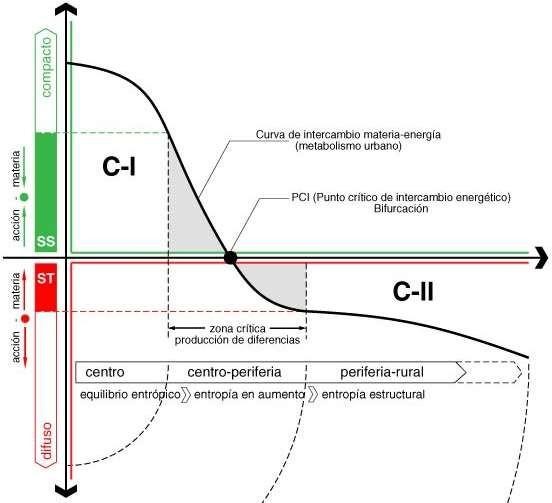
In our analysis perspective, the zones of state change or urban dispute define the cycle shift that reverses the principle of hybridization and structuring between physical and social entities (matter/action). Fragmentation as a mechanism result from transitioning from one state of organization to another. The first state is based on the polarization of linear and cellular elements with segregation of functions and large-scale socio-spatial elements (interurban commercial corridors and large commercial surfaces, gated communities separated by social strata). The second, more fragmentary state is based on highly mixed physical and social structures on a micro-scale and territorially extended. According to Borsdorf (2003), this development is only possible when functional segregation devices become concrete physical barriers. Thus, the system begins its process of reproducing structural inequality beyond its periphery, in transition zones where entropy opposes that of its original state, defining new geographies characterized by “segmented social worlds, spatially proximate, socially distant, and hierarchically connected” (Segura, 2021, p. 158).
3.2.4.Urban metabolism: complex organization
The complexity of organization in newly fragmented areas is significant due to the way matter and energy "combine and extend in space," encouraged by communication channels that distribute their intensities (Ruiz Sánchez, 2001, p. 22). Differentiation processes, which have reached a balance in terms of their physical and social components beyond the system's periphery, link the production of differences to units (parcels) and their meaning (information), thus determining a different state in their integration into the whole. Both the centre and the periphery are system fragments that derive meaning from their integration into the whole (urban system), just as inversely, the urban system maintains its significance through the identity of the centre and the periphery (Osorio, 2016). This integration in the general with identity in the particular is symmetrical to continuity and rupture as intrinsic movements of any systemic function in its resistance to the passage of time. In this sense, the new fragmentary structures ensure their identity's perpetuation at the expense of a two-way movement that stimulates "processes that transform while remaining, as well as those that, by remaining, foster processes of rupture" (Osorio, 2016, p. 37).
Within the framework of the entire system, the socio-spatial fragmentation of current peripheries acts as an urban dispute factor concerning central areas. This is because the new peripheral functions generate high expectations due to the diversity of hybridizations and the strategic nature of their locations. Among other factors, location criteria based on convenience and cost are fundamental to fostering any future transformation (Ruiz Sánchez, 2001). These conditions enable the capital (sub)system (ST) to provide the societal (sub)system (SS) with the predictability and certainty necessary for its future sustainability. This is achieved through benefits such as accessibility, identity, and a sense of belonging, exemplified by the image of progress, the absence of conflict in common spaces, and exclusivity in relations of dominance and property, among others.
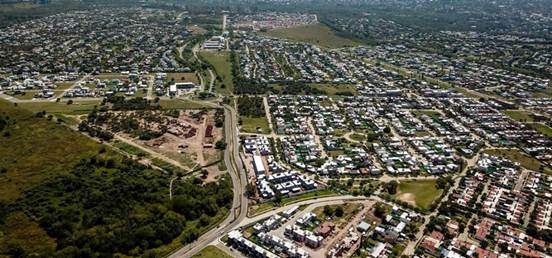
Once the hegemonic sense has been established as common sense, the capital (sub)system ultimately strengthens its speculative interests, increasing its capacity to intervene in urban dynamics by influencing official planning and regulatory processes. The second law of thermodynamics states that after the energy expenditure required to produce a transformation, the system's energy balance must be achieved. Therefore, in response to such a vast consumption of material and energy resources due to territorial expansion, an additional operation is needed to ensure the closure of the already incurred energy expenditure through the maximum simplification of structures: homogeneous fabrics in terms of the form and density of building types and monofunctionality in their relationships (Figure 6).
The problem arises when these new socio-spatial patterns, produced through hierarchical characteristic matrices (the primacy of systems is not only a matter of scale but also of their transformative power and speed), attempt to achieve functional complementarity with their environment in a context of such polarized material and energy differentiation.
Source: www.argenprop.com.ar (2023)
Figure 6: The new geographies of socio-spatial fragmentation of the current peripheries of the urban system (Córdoba, Argentina).
In these types of spatial situations, simpler structures such as gated communities have the capacity to convert any environmental disturbance into an instruction, unlike more complex structures like informal settlements, which see their operational probabilities limited due to their faster energy consumption caused by a high degree of formal and material dispersion (Ruiz Sánchez, 2001). Drawing a parallel with what Margalef posited in his studies on the evolution of ecological systems-based on asymmetric interactions-less hierarchical systems are more dissipative and less species-rich, with a more unequal distribution of species abundances compared to self-organized systems (1957, as cited in Terradas, 2015). "When a hierarchical system invades one of a smaller scale, the latter accelerates (dissipates energy faster, relying on smaller organisms with shorter lives, etc.)" (Margalef, 1957, as cited in Terradas, 2015, p. 105).
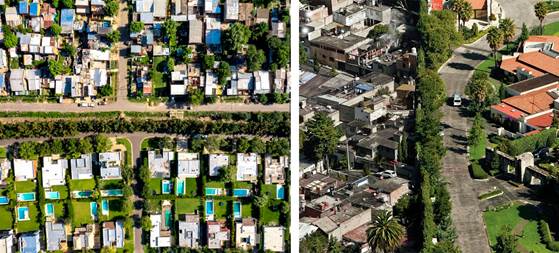
This capacity of the city to connect any operation from the environment with new system operations is the specific mechanism of autopoietic systems for the reproduction of their own components. To achieve this goal, this automated process needs to endow itself with a clear topological boundary, fundamentally based on operations observable by the system with concrete material consequences. In the same conceptual vein, Deleuze (2002) offers a conceptual critique of thermodynamics by insisting on the idea that "every phenomenon refers to an inequality that conditions it" (p. 333). Disarticulated peripheries based on physical proximity and social distance similarly reflect the configuration of new geographies topologically complementary to differences in density and intensity of energy flows, where a physical and symbolic boundary is always expressed (Figure 7). Such discontinuities can only be resolved by systems with decision-making competencies over domain and property (subsystem of capital), which use the anomalies of existing materialities as their own.
Source: www.unequalscenes.com (2023)
Figure 7: Physical proximity and social distance of state change in the new peripheries.
That is, the previous structures formed by parcels and boundary building types are subjected over time to strong processes of material renewal and reorganization, probably with consumption objectives. In other words, the parcel becomes observable by the system when its communication channels are extended, incorporating new relationships of intensity, density, and connectivity into the building type, making it not only predictable but also interesting from the perspective of its identity change. The main mechanism that capital uses to act on these state changes is the hyper-aestheticization of architectural language and the subversion of the original functions of existing structures. This is equivalent to what urban studies attribute to the processes of gentrification in the consolidated areas of degraded city centres.
4.4.1 Fragmentary logic as system identity
Fragmentation as a characteristic process of urban expansion in Latin America has been modelled by authors such as Portes and Roberts (2008); Bähr and Borsdorf (2005); Borsdorf (2003); Janoschka (2002), among others. In general, their interpretations agree on the transformative power of the fragmentation mechanism on urban structure and the singularity of a phenomenon that has been evolving for over three decades throughout the region.
The accelerated expansion of urbanization impacts the differential forms of access to favourable locations for everyday life (Di Virgilio and Perelman, 2014). In this direction, inequality in access both to land ownership-limited by the land market-and to the benefits of the road system (communication channels) that facilitate the distribution of economic flows, and consequently access to goods, services, and activities, is significant. These inequalities explain the power relations operating at different levels and dimensions of social life and constitute the frameworks of dispute over the possibility of reproducing the conditions of structural inequality within the entire urban system. This is a dispute between the class structure (as a system of classifying differences among social groups) and the urban structure (as a physical variable for access to goods, activities, and residence) where capital has become the main factor in a power system that has been territorializing social relations through the mechanism of location, configuring polymorphic and complex social geographies (Soja, 2008; Segura, 2014; Alemán, 2019).
In the realms of social interactions mediated by relationships of inequality, the intensity of material and energy flows channelled through urban land encounters resistance in social distance and the action capacity of different social groups. This translates into pressures regarding the transformation of urban land, resulting in the production of fragmentary forms of emergence aimed at equivalently resolving the tension between the building type and the parcel unit.
We will call the essence of tumoral behaviour one of the aggregation logics of form inherent to the fragmentation mechanism. This logic allows the system to not only efficiently transfer energy but also temporarily resolve the imbalance produced by inequity in access to the benefits of growth: composition of homogeneous social networks and the existence of limits and barriers (such as transportation insufficiencies, security issues, discrimination, etc.).
This results in tumoral organizations that, in a disaggregated manner, attach themselves to the homogeneous structures created by the more hegemonic system, revealing that behind the process of capturing the energy surpluses that have generated them, self-organization ensures its stability and permanence in the sequence of stable states on which it is organized (Ruiz Sánchez, 2001, De Landa, 2011). This new complexity allows for the analysis-looking ahead to future planning processes-of both the type of intra-system disputes (SS / ST) and the nature of the components (social actors) that have intervened in the process of hybridizing matter and energy (vertical axis of Figure 5). This is where the inflection point of the state change shows the transition towards a logic increasingly marked by the separation of individuals from their materialities (descending curve of the graph). These are the areas of the city susceptible to short-term planning interventions because this is where space reserves have been left at the mercy of the hegemonic (sub)systems that need to undertake their recycling actions through hyper-aestheticization. It is a fertile field of action for the more hierarchical (sub)system to produce new differences and thus begin a new cycle in its expansive process. In the urban reality, the impact can be seen in the hierarchical organization of the urban structure and the distribution of clearly differentiated activities where monofunctionally reigns as an extreme form of function polarization.
In the fragmented city, the extensively developed communication channels across the territory in a hierarchical and branching structure have fostered peri-urban and rural growth through a general process of state change ranging from polarization to fragmentation (Figure 8). Framed within urban metabolism, the logic of fragmentation between centre and periphery could be defined by how physical distance and social distance become structurally coupled, mediated topologically by equality or inequality in land access and patterns in land use.
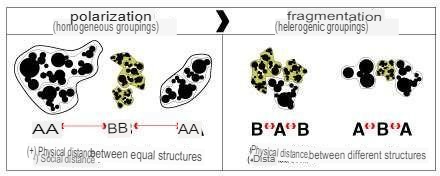
In this sense, the structures change state when they shift from a polarized organization - based on physically separated but socially proximate groupings - to a more fragmented one characterized by a mixture of both (gated communities alongside informal settlements), where physical distance is drastically reduced while social distance increases.
The conceptual intersection between thermodynamics and information, as developed through ecological perspectives such as Margalef's (1995) ideas on the "evolution" of open systems, places special emphasis on the duality of organisms as self-organized and dissipative systems. These systems evolve through a process of accumulating information and generating structures that occur when dissipated energy leaves an imprint of information on matter. These imprints function as flaws in the distribution of intensities of the information transmitted to the relational environment of the urban system, linking two mechanisms selectively (Wiener, 1948). It's an increase in dissipated energy that translates into an augmentation of the quantity of information contested by social subsystems (SS and ST) to produce material structures subordinate to the prevailing ones. This is a matter of entropy of elements that, due to their high degree of dissociation, function by increasing their complexity to facilitate new processes of renewal through prior control of the generated uncertainty, a form of control over future states that restores lost equilibrium to the system (Aquilué Junyent and Ruiz Sánchez, 2021).
This process forms the basis of the fragmentation mechanism because it assumes that in the face of entropic imbalance, material and energy flows tend to organize around the most efficient communication channels, which have been previously established by the most hegemonic subsystem: the capital's ST. In this way, the complexity difference between center and periphery allows the rural environment to function as subsidiary to urban growth, among other reasons, to balance the complexity difference caused by the centripetal dynamics that concentrate urban densities and functions towards central areas. The system transfers energy to the rural environment through communication routes extended into natural surroundings without resistance. This occurs via simple and fragmentary material structures that are more efficient for optimal expansion of messages. Since these messages are hybridizations of matter and energy associated with all elements of urban form, primarily parcels and building types, fragmentation in an unequal environment not only becomes logical but also necessary for systemic functioning.
Importance and utility of the systemic approach
Based on the arguments presented, the main contributions to the general understanding of urban dynamics are outlined as follows:
The continuity of this type of study would make it possible to achieve other degrees of precision based on the exchange of variables within the system and, therefore, other types of results that would enable instances of comparison and verification in those cases where the material effects of official planning have already become evident.

